
A Singapore buyer arranging aviation fuel needs a clear chain from the supplier’s authority to delivery and inspection. Skylink Imports specialises in procuring and supplying petroleum products and energy commodities for buyers worldwide. It connects qualified buyers with reputable suppliers, refineries, and authorized mandates to facilitate secure and efficient transactions. An authorized mandate is documented authority to represent a supplier or refinery in a transaction.
A supplier connection is not a guarantee of fuel availability or performance. Airlines and other commercial buyers need a procurement path they can assess against their operating needs. Skylink Imports can help initiate that path, while the buyer retains responsibility for evaluating the proposed transaction. The service depends on the details of each request and the counterparties involved.
Key Takeaways
- Identify each counterparty’s role in the fuel supply chain.
- Define the applicable fuel standard in the contract.
- Check the proposed route and receiving facilities.
- Compare prices only on a matching delivery basis.
- Connect payment conditions to cargo documents and inspection.
- Provide a clear grade, quantity, destination, and timing in your request.
Treat each proposed transaction as subject to independent verification and the final contract.
How to Assess The Best Guaranteed Jet Fuel Supplier in Singapore | Skylink Imports
A credible supplier can identify its role in the chain and show how its authority connects to a named source of fuel. Refineries produce jet fuel, while trading houses buy and resell it. Airport storage consortia manage shared fuel storage, and approved in-plane operators move fuel into aircraft.
Check these five points before treating a supplier as a viable counterparty:
- Supplier identity: confirm the legal name and business details.
- Authority: establish how the supplier is authorized to represent its source.
- Named source: identify the refinery or trading house connected to the offer.
- Buyer or offtake: confirm a credible buyer and intended demand.
- Access: establish the claimed storage or airport access.
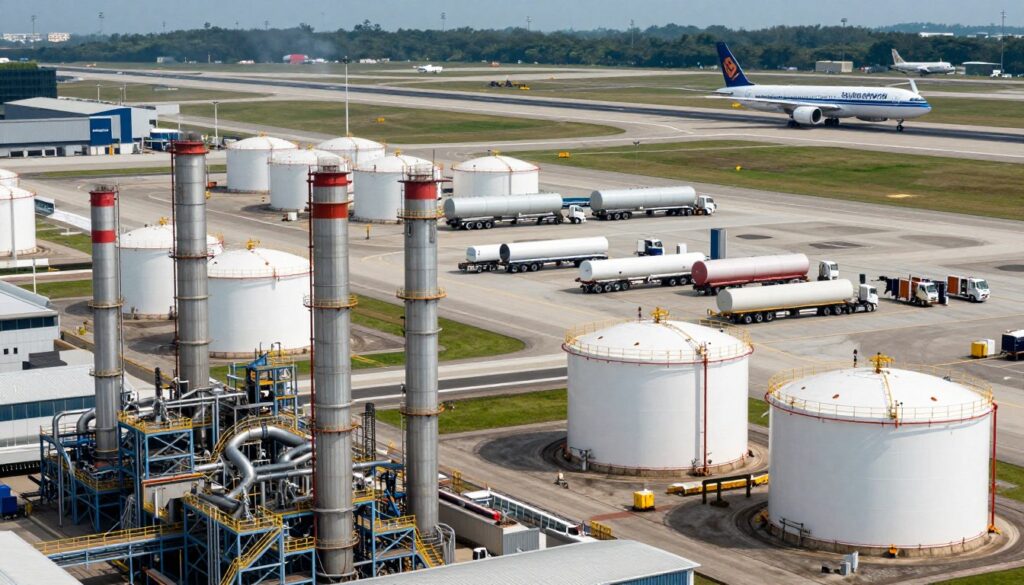
These roles matter because a company may be a direct seller, an intermediary, or a service operator. A refinery connection does not itself show that the supplier can arrange storage or airport delivery. Ask which party performs each step, and make sure the proposed chain fits your operations.
Do not treat a price formula as evidence that a supplier controls the product.
Airline fuel tenders can be contracted months or years ahead, with supplier bids commonly using an index plus a differential. Those terms suit planned fuel supply and defined volumes. A spot offer or reseller transaction needs its own validated terms, including the supplier’s role and the commercial basis.
Use the same checks whether you are an airline, fuel buyer, or commercial operator. A detailed quote may still come from a party with no confirmed source or access. Do not treat a price formula as evidence that a supplier controls the product.
Which Jet A-1 Specifications and Tests Should a Buyer Confirm?
The contract should name the Jet A-1 specification that governs acceptance before loading or discharge begins. The signed contract or national minimum standard determines the applicable fuel standard. Confirming that standard early gives the buyer and supplier a shared basis for quality acceptance.

Match the contract to the applicable fuel standard
Jet A-1 may be traded under ASTM D 1655, DefStan 91-91, or the AFQRJOS checklist. These are distinct standards or industry checklists, not interchangeable labels. The contract or national minimum standard sets the requirements for the particular transaction.
Write the full standard or checklist into the contract, including the version or edition agreed by the parties. The chosen specification defines which quality requirements apply to acceptance. A product description that says only “aviation fuel” does not make those requirements clear.
| Standard or checklist | Where it applies | Testing option |
|---|---|---|
| ASTM D 1655 | When the contract or national minimum standard selects it | SGS offers commercial Jet A-1 analysis to ASTM D1655 |
| DefStan 91-91 | When the contract or national minimum standard selects it | SGS offers commercial Jet A-1 analysis to DefStan 91-91 |
| AFQRJOS | When the contract or national minimum standard selects it | SGS offers testing to AFQRJOS requirements |
Check sampling and cargo inspection points
For a vessel-to-storage cargo, agree when inspection happens and where samples come from. Representative sampling helps ensure the material tested reflects the cargo being assessed. A sample taken at the wrong point may not represent the fuel delivered into storage.
Sampling, sample handling, and sample preparation all affect jet-fuel test results. Put the sampling point and method in the inspection instructions. Define who collects the sample, how it is sealed, and how the parties preserve its identity during transfer.
Assess the laboratory’s testing controls
SGS offers standards-based Jet A-1 testing and provides cargo sampling and inspection for product moving from vessels to storage facilities. Its inspection services cover varying cargo sizes. SGS Jet A-1 testing also includes participation in an international proficiency-testing scheme using round-robin tests.
Those round-robin tests let laboratories compare results on shared samples as part of their testing controls. Ask the inspection provider to state the test method and reporting basis. Your contract should also say which test results govern acceptance if parties dispute a finding.
Agree who takes, seals, handles, and submits each sample before inspection is underway.
How Does Singapore’s Jet Fuel Supply Chain Work?
A Singapore buyer should assess a proposed cargo as a route through specific counterparties and facilities, not just as a named origin. A refinery or trader, a storage terminal, a discharge point, and airport access are separate parts of the chain. A cargo can reach one stage without being ready for the next.
The refinery or trading source identifies where the cargo is sold into the market. The discharge point is where the vessel unloads, while a terminal receives and stores the product. Airport access depends on a further arrangement with relevant storage or into-plane operators.
When reviewing a proposed route, compare the named parties and facilities in Rotterdam, Houston, Fujairah, or Jurong. These locations can help you examine the route and terminal arrangements; their appearance in a proposal does not establish fuel availability or a direct supply connection.
Singapore became a net importer of jet fuel and kerosene in October 2024, with imports increasing from China and India. That dated market context describes a shift in trade flows, not a current price signal. It should not be used alone to infer a supplier’s inventory or the availability of a particular cargo.
Ask how the proposed cargo moves from its actual loading point to the receiving terminal. Check which party handles each leg and which facility receives the product. A named country of origin does not identify the loading berth, discharge port, or storage tank.
Ask each counterparty to identify the actual loading point, discharge point, and receiving facility for the proposed cargo.
What Does Jet Fuel Cost in Singapore?
A Singapore Jet A-1 reference was listed at $1,660/MT on 22 October 2026, but it was not a tradeable quote. The figure was indicative and five-day delayed, so it was not a firm offer for cargo.
The 22 October 2026 reference price can provide a dated point of comparison, but it does not set the amount payable in a transaction. A firm quote needs to identify the product specification, quantity, delivery basis, timing, destination, and contract terms.
Compare offers only when they describe the same commercial basis. A number without a named destination or delivery basis may leave freight and other charges outside the quoted amount. Ask whether insurance, terminal costs, or other listed charges are included, rather than assuming they are.
Freight, insurance, location, and timing can all affect the final price. A route requiring different transport or handling may not compare directly with another offer. Skylink Imports’ rates are not established by the reference figure, and no single benchmark should be treated as a seller’s price.
A buyer should distinguish an international benchmark or market reference from the actual terms of fuel supply. Jet fuel prices can be presented in different units and on different delivery bases. Confirm the unit, currency, quantity basis, and applicable charges before comparing figures.
When a quote changes with timing, make sure the offer states its validity period and delivery window. A dated reference does not hold a price open for a buyer. Compare firm offers only after the delivery basis and included charges are aligned.
Which Buying Procedure Fits Your Cargo?
FOB suits a buyer able to arrange freight, while CIF places ocean freight and marine insurance with the seller. The right procedure depends on who arranges freight, where product transfers, and what the signed contract says.
FOB requires a buyer-arranged vessel or freight
Under FOB, you arrange the vessel or a freight relationship to collect the cargo. In the stated procedure, payment by MT103 follows the loading inspection and issuance of the bill of lading. Payment is made against the shipping documents after those steps.
That sequence requires a workable freight plan and a clear understanding of the loading point. Confirm that the contract sets out the inspection, shipping documents, and payment trigger. A buyer without a vessel arrangement may find this procedure difficult to carry out.
CIF includes seller-arranged ocean freight and insurance
Under CIF, the seller arranges ocean freight and marine insurance to the named discharge port. In the stated procedure, title transfers at the loading port. The signed contract must state title transfer and risk allocation explicitly, as they are separate terms.
Read the contract for the named destination and the parties’ obligations at each stage. Do not assume that payment, title, and risk pass at the same time. The contract should specify how those points relate to the shipment and delivery conditions.
TTT, TTO and TTV depend on the transfer point
Tank-to-tank transfer (TTT) moves product between terminal tanks. Tank takeover (TTO) involves taking over product in a tank under agreed terminal terms. Tank-to-vessel pumping (TTV) moves fuel directly from a terminal tank into the buyer’s nominated vessel.
Terminal confirmation and contract terms govern how TTT and TTO are executed. For TTV, the stated procedure bases payment on the quantity actually injected after loading inspection. The transfer point and measured quantity should be clear before the parties act.
| Procedure | Freight or transfer arrangement | Payment or title point |
|---|---|---|
| FOB | Buyer arranges vessel or freight relationship | MT103 after loading inspection and bill of lading issuance |
| CIF | Seller arranges ocean freight and marine insurance to named discharge port | Title transfers at loading port in the stated procedure |
| TTV | Terminal pumps fuel into buyer’s nominated vessel | Payment uses quantity injected after loading inspection |
Confirm the transfer point, title terms, and quantity basis in the signed contract before funds move.
What Documents and Payment Checks Protect a Fuel Purchase?
Release payment only against documents and inspection conditions that match the signed contract. Any mismatch in cargo identity, quantity, or quality can change what the buyer is agreeing to pay for.
Build a document set that matches the contract
A transaction document set commonly includes a bill of lading, commercial invoice, certificate of quality, inspection report, and certificate of origin. Match each document to the contract’s parties, cargo description, quantity, and timing. The fields should describe the same transaction.
| Document | What it helps verify | Cross-check |
|---|---|---|
| Bill of lading | Shipped cargo and vessel | Vessel name, loading point, quantity, and parties |
| Commercial invoice | Seller’s charge for the cargo | Buyer, seller, product, quantity, and contract price |
| Certificate of quality | Reported fuel quality | Jet A-1 specification, sample, and test result |
| Inspection report | Inspection findings for the cargo | Sampling point, quantity, date, and findings |
The certificate of origin should also correspond to the cargo description and stated origin. A document title alone does not prove that its details match the shipment. Compare the documents as a set, including names and quantities that appear across several records.
Verify the cargo, vessel and counterparties
Confirm the counterparty’s authority and examine proof-of-product documents independently. Fabricated proof-of-product documents are a potential FOB risk. Disputes can also arise over vessel specifications or demurrage at the loading berth, so the contract should address those details.
For CIF cargo, check the vessel against live AIS data before releasing payment, and arrange a discharge-port surveyor. Use this four-point check:
- Verify the vessel’s identity and movement in live AIS data.
- Independently confirm the terminal or berth details.
- Appoint a discharge-port surveyor for CIF cargo.
- Reconcile inspection findings with the payment conditions.
Set inspection and payment release conditions
Write payment release conditions into the contract before the transaction begins. State which documents and inspection findings must be received, and how the parties will resolve discrepancies. Do not leave the release decision to a later informal exchange.
Keep the inspection report tied to the agreed sampling point and cargo quantity. If a document conflicts with the contract, the parties should resolve that conflict before payment falls due. Hold payment if vessel, cargo quantity, or inspection details conflict with the agreed transaction documents.
How Should Buyers Plan Delivery to Airports and Terminals?
A cargo reaching a port is not yet the same thing as fuel being available at an airport. Discharge, terminal receipt, storage, onward transport, and airport access are distinct logistics stages. A schedule is useful only if it accounts for each handover.
Start with the named discharge port, then identify the receiving terminal and available tank arrangement. The cargo must be received and stored before any onward movement can happen. Airport access or an end-use handover may require arrangements beyond the port and terminal.
Use this route checklist when you assess a proposed delivery:
- Confirm the named discharge port.
- Verify the receiving terminal and tank availability.
- Confirm onward transport or transfer rights.
- Establish the airport or end-use handover arrangement.
Jurong, Rotterdam, Houston, and Fujairah are locations to check against the proposed route and counterparties. Their appearance in a route does not establish assured supply. Confirm how the cargo moves between the named port, terminal, and end user.
Airport delivery plans should name the receiving point and the party responsible for each stage. A vessel schedule alone does not confirm terminal acceptance or airport access. Clarify whether the terminal can receive the planned cargo and whether the onward handover fits the schedule.
Obtain written confirmation of the receiving terminal and onward delivery arrangements before accepting the schedule.
How Can Skylink Imports Support Jet Fuel Procurement?
Skylink Imports works in petroleum-product and energy-commodity procurement and supply for buyers worldwide. Its stated role is to connect qualified buyers with reputable suppliers, refineries, and authorized mandates to facilitate secure and efficient transactions.
To assess a potential connection, provide the intended grade, quantity, delivery basis, destination, and timing. Those details help show whether a proposed supplier relationship fits your requirements. A broad inquiry may not show whether a particular cargo route or transaction structure is relevant.
Buyers can also review Skylink Imports’ procurement services for commercial buyers to understand its wider procurement role. That diesel-focused material does not establish Jet A-1 availability or aviation-fuel expertise for a particular transaction.
A supplier introduction is a starting point for assessing the proposed parties and terms. Skylink Imports does not thereby establish that it owns inventory, controls refinery output, or can guarantee delivery, quality, price, or transaction results. Each supplier, authorized mandate, cargo, and contract still requires independent verification.
Keep the request focused on your actual operating need. A buyer’s grade, destination, and timing can shape which counterparties or transaction structures are worth considering. The proposed service remains subject to the terms and capability of the parties involved.
Treat a supplier introduction as the start of due diligence, not as proof that a cargo is available.
What Should Buyers Include in a Jet Fuel Request?
A useful purchase request gives the supplier enough detail to assess the cargo and delivery route. State the grade and specification, quantity, target timing, delivery basis, destination, and your role in the transaction.
Name Jet A-1 and the applicable standard, such as ASTM D 1655 or DefStan 91-91. Give the requested quantity and delivery window, then state whether you are considering FOB, CIF, or another basis. For a Singapore request, name Singapore or the intended receiving terminal, such as Jurong.
Explain whether you are the end buyer, a buyer’s representative, or another participant. Include your ability to meet the proposed procedure, such as arranging freight when required. A request should make clear whether you want an indicative discussion or are asking for a firm offer.
Do not send sensitive identity or financial records before you have verified the counterparties and agreed on a secure process. Share only the information needed for the initial assessment. The first exchange can describe the commercial requirement without exposing confidential records.
Keep the initial inquiry specific enough to screen for a workable transaction, but share sensitive records only through a verified process.
This keeps the opening exchange useful without turning it into an unverified document transfer. If your destination or quantity is still being finalised, state that clearly rather than presenting an estimate as fixed. Keep the initial inquiry specific enough to screen for a workable transaction, but share sensitive records only through a verified process.
Conclusion
A defensible Jet A-1 purchase depends on matching the supplier, specification, documents, and delivery plan. Your decision should rest on a verifiable supplier and authorized mandate, a contract-defined fuel standard, and transaction records that align with the cargo and delivery plan.
Start with one practical step: prepare a request for Skylink Imports stating the grade, quantity, delivery basis, destination, and timing. Those details give the company a basis to assess whether a supplier connection may fit your requirement. Any offer remains subject to independent checks and a signed contract.
Prepare those five transaction details before requesting a supplier connection.
FAQ
What is the difference between Jet A and Jet A-1?
Is a delayed Jet A-1 reference price the same as a firm offer?
Can a buyer use an independent inspector for a fuel cargo?
Can CIF terms guarantee that the cargo will reach the discharge port?
What should a buyer check before accepting proof of product?
Should title and risk transfer be treated as the same thing?