
The UAE’s sustainable aviation fuel policy targets local SAF production capacity of 700 million liters annually by 2030. We connect buyers with Jet A-1 sources for spot transactions and long-term contracts. Into-plane fueling is the final airport delivery step that moves fuel from airport storage to the aircraft.
Our expertise connects buyers with sources across the supply chain, supporting business needs for EN590 10PPM Diesel, Jet Fuel A1, LNG, LPG, Crude Oil, D6, Bitumen, and other petroleum products. We aim to build lasting business relationships through clear terms and procurement support.
Buyers can use this guide to assess Jet A-1 offers, delivery options, and commercial terms before they respond to tenders or discuss a contract. The SAF capacity goal is market context, not a promise about Jet A-1 supply or availability.
Key Takeaways
- Match the offered grade to the contract requirement.
- Check the counterparty, source path, and delivery point.
- FOB and CIF apply to sea and inland-waterway shipments.
- State an airport, terminal, or port as the delivery endpoint.
- Treat market benchmarks as context, not firm delivered quotes.
Treat that SAF capacity goal as market context, not evidence of a particular Jet A-1 cargo or supplier’s availability.
Jet A-1 Fuel Supplier UAE: How Buyers Can Qualify One
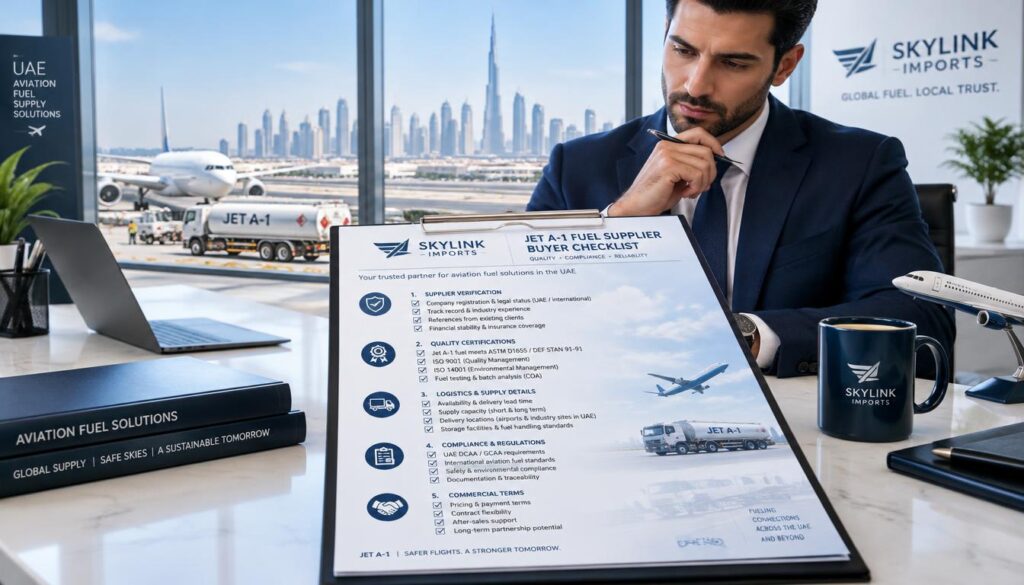
A buyer can qualify a fuel supplier by verifying the contracting entity, the supply path, the exact grade, the delivery point, and the written scope of responsibility. Clear answers help buyers compare suppliers and protect the business from gaps between an offer and delivery.
Use five checks to test whether a supplier can meet the stated requirement. Jet A-1 is a kerosene-grade turbine fuel used in civil and military turbine-engine aircraft.
Verify the counterparty and supply path
Start with the legal name of the entity that will sign the contract and receive payment. Ask how the fuel moves from its source through each custody point to the agreed delivery endpoint.
Then compare the offer with the named grade and specification, such as DEF STAN 91-91. Ask the supplier to explain how it will meet the buyer’s quality and delivery requirements.
- Legal counterparty: confirm the contracting entity and its role.
- Source and custody path: identify the fuel source and each handoff.
- Named specification: state the grade and governing specification.
- Delivery endpoint: name the port, terminal, airport, or aircraft.
- Written scope: list the supplier’s commercial and delivery duties.
A tender response that leaves the contracting counterparty or delivery endpoint unclear needs clarification before award.
Supplier responses to tenders should make the supply route and delivery responsibilities clear. Procurement support is separate from employment information; aviation fuel careers commonly involve fuel quality, airport fueling operations, logistics, and safety roles.
Match the supplier’s offer to the delivery point
Spot transactions, long-term offtake agreements, and tenders can each shape the commercial offer. The buyer should check whether the supplier’s stated capability matches the requested endpoint and the written scope.
A counterparty may coordinate a supply path without controlling every physical handoff. Ask which party handles each stage, then record the answer in the commercial documents.
Certifications can support a buyer’s review, but their meaning depends on the named activity and product. Ask the supplier to connect each certification to the proposed transaction rather than treating a certificate as proof of every duty.
A tender response that leaves the contracting counterparty or delivery endpoint unclear needs clarification before award.
Which Jet A-1 Specifications and Documents Should Buyers Verify?
For turbine aircraft fuel procurement, the named grade and its governing specification are the first technical checks to match. Jet A-1 is commonly specified for international supply, while Jet A is more common in the United States.
Match the offer’s specification and batch records to the transaction documents. Jet A and Jet A-1 are aviation turbine fuels, and both have defined quality limits.
Jet A-1, Jet A, and SAF fuel classifications
The aviation fuel name commonly specified for international supply is Jet A-1; Jet A is more common in the United States. Jet A-1 has a minimum flash point of about 38 °C and a maximum freeze point of approximately -47 °C.
ASTM D1655-26b, last updated August 10, 2026, defines minimum property requirements for Jet A and Jet A-1. ASTM’s D1655 standard covers aviation turbine fuels, including these grades.
ASTM D1655 addresses composition, volatility, fluidity, combustion, corrosion, thermal stability, contaminants, and additives. ASTM D7566-26a, last updated July 30, 2026, covers turbine fuel made from conventional and synthetic blending components.
Check the specification and batch records
Fuel certified and released under ASTM D7566 is regarded as D1655 turbine fuel. This links the standards: D7566 covers production pathways, while D1655 sets requirements for the released turbine fuel.
Match the certificate of analysis, safety data sheet, batch reference, and stated specification to the transaction documents. These records help show whether the offered jet fuel and its quality match the contract.
Use the same grade and specification in the offer, contract, and batch records. A different label can cause confusion when buyers compare products or review aviation fuel documents.
Do not treat a product name alone as evidence that its batch meets the contract specification.
FOB and CIF: Who Pays, and When Does Risk Transfer?
FOB and CIF both transfer risk at the shipment’s origin, but CIF also requires the seller to pay freight and insurance to the named destination port. The risk point does not move just because one party pays more of the transport cost.
Under Incoterms 2020, FOB and CIF apply only to sea and inland-waterway shipments. FCA can serve any transport mode, including air, road, rail, or a mix.
| Incoterm | Permitted transport mode | Seller’s freight and insurance responsibility | Risk-transfer point |
|---|---|---|---|
| FOB | Sea and inland waterway | Seller is not required to pay freight or insurance to destination | When goods are on board at the shipment port |
| CIF | Sea and inland waterway | Seller pays freight and insurance to the named destination port | When goods are on board at the origin port |
| FCA | Any transport mode | Seller is not required to pay main carriage or insurance | When seller hands goods to buyer’s carrier at the named place |
For FOB, the seller delivers the fuel on board the vessel at the port of shipment. Risk then passes to the buyer, even though the journey continues.
Under CIF, the seller pays freight and insurance to the named destination port. CIF risk transfers at origin, when the goods are on board the vessel, despite the seller’s later transport payments.
That difference matters when buyers compare fuel offers, products, and terms. A lower transport bill does not change the risk-transfer point in the Incoterm.
FOB and CIF are not a substitute for defining an airport delivery arrangement. Specify the physical endpoint and the party responsible for each stage.
Check that the chosen Incoterm names the correct port or place and the applicable Incoterms 2020 rule.
How Does UAE Airport Delivery Reach the Aircraft?
An airport fuel contract can end at a storage terminal or extend to the aircraft, so the delivery endpoint should be explicit. The final handoff differs from bulk delivery into airport storage.
Into-plane fueling moves fuel from airport storage to the aircraft. The physical supplier provides a fueling receipt for the uplift, but that receipt does not replace the contract’s full quality and batch records.
Bulk movement into airport storage
A cargo or bulk movement may first reach a terminal or other storage point. Fuel then moves onward to airport storage under the supply arrangement.
The contract should say whether delivery ends at a port, terminal, or airport storage facility. Buyers can name Dubai International (DXB), Abu Dhabi International (AUH), or Sharjah International (SHJ) when they specify an airport endpoint.
A supplier’s stated route should match the requested physical endpoint. Naming an airport does not, by itself, establish that a particular supplier serves it.
The aircraft-side into-plane handoff
At the aircraft side, the physical supplier carries out the uplift from airport storage. The fueling receipt records the quantity, observed density, batch reference, and supplier quality-certification status.
The receipt documents the uplift rather than every part of the sale. Buyers can reconcile its details with the agreed delivery record and the separate batch documents.
The receipt also gives the buyer a record tied to a specific fueling event. Keep it with the transaction records so the delivered quantity and batch can be traced.
Reconcile the receipt’s quantity and batch reference with the uplift and the agreed delivery record.
Jet Fuel Pricing, Contracts, and UAE SAF Rules
The $178.95-per-barrel global average is a benchmark, not a firm delivered price for a UAE airport or a named airline. Actual offers need a defined grade, quantity, place, timing, and delivery basis.
The IATA Jet Fuel Price Monitor reported a global average of $178.95 per barrel for the week covered by its 2026 report, down 6.6% from the previous week. That figure is not an Emirates-specific quote.
Benchmarks, firm quotes, and contract routes
Jet A and Jet A-1 are aviation turbine fuel grades. An airplane fuel name and price need to be read together with the grade, volume, location, timing, and delivery terms.
Buyers comparing an Emirates fuel price with a supplier offer should match grade, location, timing, volume, and delivery basis. A global weekly average does not set the price for fuel delivered to a UAE airport.
Spot purchases, tenders, and long-term contracts can support different buying plans. Each request should state the same commercial facts so suppliers can respond on a comparable basis.
Include these five fields in a quote request:
- Fuel grade and volume
- Delivery airport, terminal, or port
- Requested delivery window
- Incoterm and named place
- Required batch and sustainability documents
We at SKYLINK IMPORTS discuss Jet A-1 requirements at info@skylinkimports.com or USA +1 (432) 243-4545. A clear request helps our team understand the intended delivery and contract route.
UAE SAF documentation and export controls
The UAE targets local SAF production capacity of 700 million liters annually by 2030. Its voluntary use target calls for locally produced SAF to make up at least 1% of fuel used by national airlines at UAE airports by 2031.
SAF exports from the UAE require technical certification, ICAO sustainability certification, and licensing certification accredited by the licensing authority.
UAE policy allows SAF production at three to five plants, using pathways that include saltwater-grown plants and solid-waste recycling. SAF producers and suppliers manage blending according to UAE-approved ratios.
Airport fuel suppliers must provide aircraft operators buying SAF with comprehensive sustainability documentation. Buyers can identify the needed evidence by supply-chain role:
| UAE supply-chain role | Policy responsibility | Buyer-facing evidence or check |
|---|---|---|
| SAF producers and suppliers | Manage blending under approved ratios | Blending details and applicable sustainability records |
| Airport fuel suppliers | Provide comprehensive sustainability documents to SAF buyers | Documentation for the aircraft operator’s purchase |
| Export-terminal or port facilities | Support exports subject to required certifications | Technical, ICAO sustainability, and accredited licensing certifications |
A firm offer should state the grade, quantity, delivery point, timing, and applicable delivery term in writing.
Conclusion
A workable Jet A-1 transaction starts with an agreed grade, a clear delivery endpoint, and written commercial responsibilities. Buyers can reduce confusion by aligning those details before committing to a fuel supply arrangement.
Our team can review a requirement for the intended airport, terminal, or port and discuss a suitable procurement route. Share the grade, quantity, timing, and delivery basis so we can understand the request.
Send us the required grade and delivery point to begin a procurement discussion.
FAQ
Does CIF mean the seller keeps the risk until the fuel reaches the destination port?
Can FOB be used for an air shipment of aviation fuel?
Does an into-plane receipt replace the batch certificate of analysis?
Can SAF be treated as conventional Jet A-1 in a supply contract?
Why might a global jet fuel benchmark differ from a UAE delivered offer?
What information should a buyer send for a Jet A-1 quote?
E-MAIL US
info@skylinkimports.com