
A US buyer comparing two diesel offers can face different sulfur limits and different permitted uses even when both are called diesel. A familiar label can hide a costly mismatch.
The key is to match the contract specification to the fuel’s intended use, destination rules, and delivery basis. A seller’s grade name alone does not prove compliance.
For fuel sulfur, ppm means parts per million, a concentration unit; ppm by mass equals mg/kg. That unit helps buyers compare test results with contract limits.
This guide gives buyers a practical way to compare offers before they commit. It focuses on the product, its use, and how a cargo is checked.
Buyers should also account for season, transport, and the documents that support a sale. Those details can change whether a quoted grade fits a real need.
The first step is to understand what the names mean in a fuel transaction.
Key Takeaways
- EN590 is a defined automotive fuel standard.
- AGO is a broad commercial grade name, not one fixed specification.
- Compare full cargo test results with the destination and end use.
- Write the required grade, edition, and quality limits into the contract.
- Compare offers using the same delivery basis and dated benchmark.
What Do EN590 and AGO Mean in a US Fuel Deal?
EN590 identifies a defined automotive fuel standard, while AGO describes a broader gasoil category. Those names do not set the same level of detail.
Both products are middle-distillate diesel fuels, but EN590 fuel is not a synonym for every diesel grade. Buyers need the actual offered specification, not just its commercial name.
EN590 names a defined automotive standard. AGO names a broad category, so its cargo specification must be stated separately.
EN590 sets requirements for automotive diesel in markets that use the standard. AGO, or Automotive Gasoil, is a commercial grade name with no single universal specification.
That distinction can cause confusion in an international trade. A seller may use AGO for a product with sulfur or other properties that differ from another AGO cargo.
AGO is commonly used in African, Middle Eastern, and Asian markets. The grade may suit a buyer’s local equipment or rules, but its name does not prove that fit.
A buyer should ask for the complete specification tied to the offered product. The document should identify the tested properties and the limits the parties have agreed to.
That step matters when an importer compares a foreign offer with a domestic automotive diesel requirement. Similar appearance or use does not make two fuels interchangeable.
Commercial offers may also use terms such as grade, standard, and market category loosely. The signed documents should make clear which meaning applies to the deal.
The names explain the basic product types, but they do not settle suitability. Buyers can compare the differences directly by checking the named properties.
EN590 vs AGO Diesel: Key Differences for US Buyers
The clearest commercial distinction is that EN590 has a defined sulfur ceiling while AGO does not have one universal specification. That gap matters in a fuel deal.
EN590 has a maximum sulfur limit of 10 mg/kg; AGO has no single universal sulfur limit. Buyers should compare the offered specification, not assume equivalence.
| Attribute | EN590 | AGO |
|---|---|---|
| Sulfur definition | Maximum 10 mg/kg | No single universal limit |
| Standard or grade status | Defined automotive standard | Broader commercial grade |
| Common application | Road automotive diesel | Trucks, buses, generators, construction machinery |
Both are fuel grades used in diesel engines, but their labels do not carry equal meaning. EN590 points to a standard; AGO needs a cargo-specific definition.
That distinction does not make one product automatically better for every buyer. A generator operator and a road-fleet manager may face different requirements.
A quote should state the exact product and its key test limits. The buyer can then compare those values with the equipment and destination needs.
Use the specification attached to the cargo, rather than a general product description. This avoids judging a product by a label alone.
The side-by-side comparison gives buyers a starting point, not a full quality review. Named technical parameters make the difference testable.
Which Specifications Separate EN590 From Broad AGO Grades?
A grade comparison becomes meaningful only when it includes named test values and limits. Specific figures let a buyer judge the offered fuel.
EN590 sets several measurable properties, while AGO must be tied to its cargo specification. For AGO, buyers should confirm the cargo specification rather than assume a universal limit.
| Parameter | EN590 requirement | What an AGO buyer must confirm |
|---|---|---|
| Sulfur | Maximum 10 mg/kg | Confirm the cargo specification |
| Cetane | Minimum number 51; index 46 | Confirm the cargo specification |
| Density | Earlier editions: 820-845 kg/m³ at 15°C | Confirm the cargo specification |
| FAME | Maximum 7.0% by volume | Confirm the cargo specification |
Cetane number and cetane index describe ignition quality in different ways. A buyer should check which value the offer reports and what limit applies.
Density is tied to temperature and the standard edition. Earlier EN590 editions specified 820-845 kg/m³ at 15°C, so the contract year matters.
FAME means fatty acid methyl ester, a biodiesel component measured by volume. The stated EN590 maximum is 7.0% by volume.
Some market quotes refer to Platts Gasoil 500 ppm. A 500 ppm index is a pricing reference, not proof that every AGO cargo contains that sulfur level.
The figure in an index name does not replace a laboratory result. Buyers should use the agreed cargo specification to assess quality.
These figures help separate the products, but US buyers must also compare them with domestic road-fuel requirements.
How Does EN590 Compare With US Road Diesel Rules?
EN590’s sulfur ceiling is lower than the US on-road diesel maximum, but that single parameter does not settle compliance. Sulfur alone cannot approve a fuel.
US on-road diesel is generally subject to a 15 ppm sulfur maximum, while EN590 has a 10 ppm maximum. The lower sulfur figure does not make the grades fully equivalent.
Compliance can depend on more than sulfur content. The destination, fuel properties, and intended use all matter to the decision.
US buyers should not treat a foreign standard name as automatic approval for a domestic vehicle. The contract needs to match the actual rules for the use.
That point is important for automotive diesel destined for public roads. A product can meet one familiar limit and still fail another required condition.
Before accepting an import, the buyer should confirm destination and end-use requirements with the relevant authority. That check helps avoid relying on an unfamiliar grade label.
Some buyers may need fuel for private sites or stationary equipment instead. Those uses still require a clear specification and a fit with the equipment maker’s guidance.
Once the destination rules are clear, the next question is which equipment and buyer groups may need each grade.
Which Buyers and Equipment Fit Each Grade?
A fleet supplying modern road vehicles has a different fuel decision from a site running stationary generators. The equipment’s job helps shape the grade choice.
Modern road fleets often need tightly specified, low-sulfur automotive diesel. Fuel must match the engine, emissions controls, and rules for its use.
That need is especially clear for vehicles with exhaust after-treatment systems. A buyer serving those fleets should follow the customer’s written fuel specification, not a general diesel label.
Automotive diesel buyers can include fleet operators, importers, and fuel distributors serving a defined market. They may choose EN590 because a customer contract names that standard.
Modern road fleets and low-sulfur requirements
A modern road fleet may have strict emissions controls and a clear supply contract. The fleet manager needs proof that each delivered batch matches those requirements.
An importer might select EN590 for a customer who requests a named automotive standard. That choice reflects the customer’s specification, not a claim that EN590 is universally superior.
Buyers should identify the vehicle type, local rules, and required quality documents before arranging volume. This keeps the order tied to a real end use.
Generators, buses, and off-road machinery
AGO is commonly used for trucks, buses, generators, and construction machinery in markets with different requirements. Its actual properties still need to fit the equipment.
Stationary power generation differs from US public-road use. A generator at a remote site may face different rules from a truck operating on public streets.
Off-road machinery also has a specific duty cycle and fuel need. A broad grade name cannot replace the equipment maker’s fuel guidance or local requirements.
Older equipment and destination-specific needs
Older engines may have different fuel needs from modern engines with emissions controls. Age alone does not establish which product is safe or allowed.
A buyer should check the engine manual and the destination rules. That is more useful than assuming an older machine accepts any diesel product.
Volume can shape how a buyer arranges a supply, but it does not change the fuel’s required quality. Each cargo still needs a defined specification.
Matching equipment with a grade narrows the choice. Buyers still need to ask whether one grade can replace another for a specific engine or destination.
Can AGO Replace EN590 in US Road Vehicles?
A US buyer should not approve AGO for a road vehicle based only on the word diesel in the offer. The broad label proves too little.
AGO is suitable only if its actual cargo specification meets the vehicle and destination requirements. A broad grade name does not show that it does.
Higher-sulfur fuel can be incompatible with emissions after-treatment systems. The risk is not limited to performance; the wrong fuel may damage parts or break rules.
Before substitution, the buyer should compare cargo test results with the vehicle manufacturer’s fuel requirements. Destination rules also matter to the decision.
A seller’s general product sheet may not describe the cargo offered for a specific transaction. Buyers should ask for results tied to that shipment.
The answer can differ for off-road or stationary equipment. Those machines may have other fuel needs, though local rules and the engine maker still apply.
Road use is therefore not a place to guess from a grade name. A documented match is the safer basis for approval.
Even a well-matched grade can fail a seasonal need, so buyers should check the edition and quality details too.
Which Seasonal and Quality Details Can Change the Choice?
A cargo that meets a buyer’s basic grade description can still be wrong for the delivery season. Cold-flow behavior can decide whether fuel works.
EN590 cold-filter plugging point grades depend on climate and season. Contracts should name the seasonal grade and the standard edition.
Cold-filter plugging point, or CFPP, measures how well fuel can pass through a filter in cold conditions. A suitable value depends on the climate and use.
Summer and winter grades
Summer and winter material are not interchangeable where cold-flow behavior matters. Fuel chosen for warmer weather may not pass filters reliably in colder conditions.
The delivery season and destination climate should guide the seasonal grade. Buyers should also consider how the equipment will store and use the fuel.
A shipment arriving near a change in season can need special care. The buyer should align the delivery window and fuel requirement in the order.
EN590 edition and year
EN590:2025 superseded EN590:2022. EN590:2025 lowered the summer minimum density from 820.0 to 815.0 kg/m³ at 15°C.
EN590:2025 also added a limit of 10,000 particles per milliliter for particles 4 µm and larger. Those edition changes can affect what a buyer expects from a cargo.
A contract that says only EN590 may leave the applicable edition unclear. The offer and signed terms should state the year and edition directly.
Cold-flow and cleanliness checks
Cleanliness matters as well as cold flow. The newer particle requirement shows why buyers should define the edition and relevant test limits.
Three checks can help buyers choose the correct material:
- Match destination climate with the delivery season.
- Confirm the standard edition named in the offer.
- Check cold-flow needs for the equipment.
These choices establish what the cargo should meet. The next task is confirming the delivered fuel actually meets it.
How Should Buyers Verify the Cargo and Loading Terminal?
A grade name and a document packet cannot confirm the contents of a cargo without independent checks. Testing the cargo gives buyers stronger evidence.
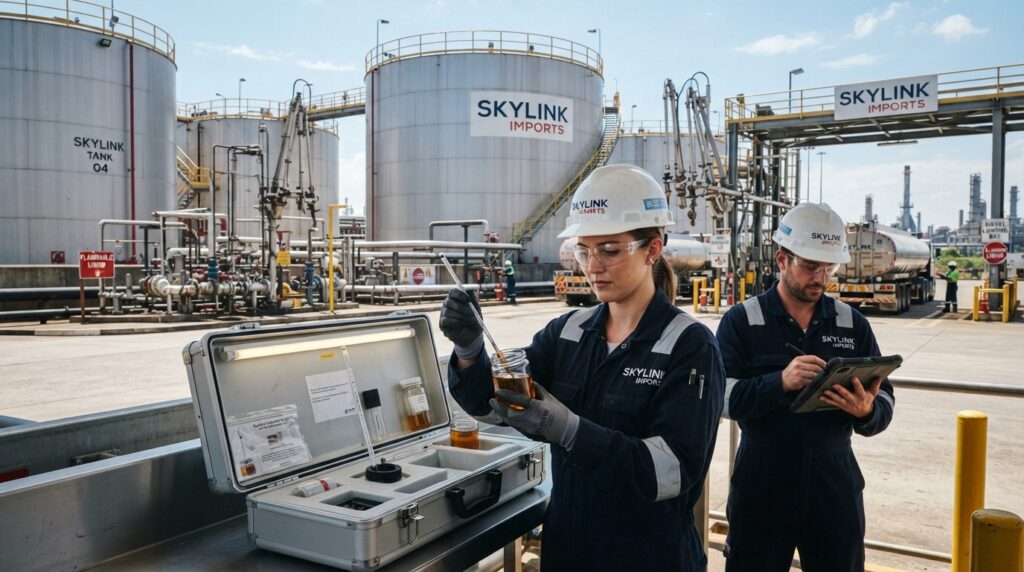
Request the complete specification and an independent quality and quantity inspection at the loading terminal. A Q&Q report records measured quality and quantity.
Proof of product, often called POP, is a separate transaction document. It does not replace independent testing or prove that test results match the contract.
Buyers arranging a verified EN590 supply should keep the supplier, cargo, and inspection records aligned. Each document should identify the same transaction.
A Q&Q inspection can help resolve questions about measured properties and volume. The inspection terms should say what gets tested and when the report is issued.
The inspection arrangement and terminal schedule set the testing turnaround time. Opening hours and available inspection hours can vary by terminal and appointment.
Use this checklist before accepting a cargo:
- Verify the terminal and cargo identity.
- Compare test results with the contracted limits.
- Confirm document authenticity with the issuing party.
Independent results become useful when the sale terms say what the cargo must meet. Buyers should put those requirements into the contract.
What Should the Sale Contract Specify?
If a specification is not written into the agreed transaction documents, it may be difficult to enforce. Clear terms reduce disputes.
The signed contract should state the grade, standard edition, and key limits. Informal correspondence should not replace agreed transaction documents.
| Contract field | What the agreement should name | Why it matters |
|---|---|---|
| Grade and standard edition | Product name and edition year | Sets the applicable requirement |
| Sulfur limit and test method | Limit and named test method | Defines how sulfur is judged |
| Seasonal grade and key quality limits | Seasonal grade and agreed limits | Links fuel to use and climate |
| Inspection documents | Q&Q report and delivery date | Sets evidence and timing |
Payment documents should reflect the agreed specifications when they form part of the transaction. The buyer should avoid gaps between the sale contract and related paperwork.
Each trade party should agree who supplies each test report. The agreement should also state when each report is due and which cargo it covers.
Clear terms help if a test result falls outside a limit. The parties can see which measurement, method, and document control the decision.
Buyers should also define how seasonal grade and other quality limits will be judged. A broad phrase can leave room for avoidable disagreement.
Once the grade and proof are clear, buyers can compare the quoted cost on a like-for-like basis.
What Affects EN590 and AGO Prices?
A diesel quote is meaningful only when its benchmark, date, location, and delivery basis are clear. A price without those details is hard to compare.
EN590 pricing commonly uses Platts Diesel 10 ppm FOB Rotterdam plus a premium. AGO pricing commonly uses Platts Gasoil 500 ppm or regional gasoil indexes.
The EN590 diesel price today changes with the quote date, benchmark, premium, location, volume, and delivery basis.
Benchmarks used for each grade
The EN590 10 ppm price today is usually linked to the relevant 10 ppm diesel benchmark and a premium. AGO quotes often use a 500 ppm or regional gasoil index.
A market index is a reference for pricing, not the full price of a delivered cargo. The premium and transaction details also shape the offer.
| Quote item | EN590 | AGO |
|---|---|---|
| Common benchmark reference | Platts Diesel 10 ppm FOB Rotterdam | Platts Gasoil 500 ppm or regional index |
| Index or premium basis | Index plus a premium | Index-based quote |
| Details needed to compare offers | Date, location, volume, FOB or CIF | Date, location, volume, FOB or CIF |
Variables that change a delivered quote
Volume can affect the quoted premium, while location and delivery basis affect the cost included. Each offer needs the same comparison points.
Buyers should also note whether the quote covers freight and insurance. A price with one delivery basis cannot be compared fairly with a different basis.
Asking how much EN590 costs per metric ton has no timeless answer. The dated benchmark, premium, location, volume, and FOB or CIF basis set the amount.
Why a live price needs a date and basis
A current Platts value must match the relevant publication and date. A value from another date may not reflect the quote being reviewed.
Buyers should record the quote date and benchmark reference with the offer. That keeps a later comparison tied to the same market point.
Delivery terms also affect what a quote includes and who arranges transport.
What Do FOB and CIF Change for a US Importer?
Two offers for the same grade can cover different transport costs and responsibilities. The delivery term explains who handles each task.
Under FOB, the buyer arranges the main ocean carriage. Under CIF, the seller arranges and pays for carriage and minimum insurance to the named destination.
| Term | Seller’s main responsibility | Buyer’s main responsibility |
|---|---|---|
| FOB loading and export obligations | Load goods and clear export | Arrange main ocean carriage |
| CIF freight and insurance to named destination | Arrange carriage and minimum insurance | Handle arrival and import steps |
| Risk transfer | Risk transfers when goods are on board | Risk transfers at loading port |
Under both FOB and CIF, risk transfers when the goods are on board at the loading port. CIF does not mean the seller carries risk through arrival.
That difference matters because cost responsibility and risk transfer are not the same thing. Buyers should read both parts of the term carefully.
The agreement should name the port and applicable Incoterms version. A named destination alone may not clear up every shipping duty.
Under CIF, the seller pays for freight and minimum insurance to the named destination. The buyer still needs to understand what happens once the cargo arrives.
After comparing delivery structure, buyers can look at the supply channels and origins they can verify.
Where Can US Buyers Source EN590?
EN590 can be produced wherever a refinery can make fuel that meets the standard, so buyers should verify the actual origin and cargo. Country alone does not prove quality.
Buyers commonly approach refineries, authorized fuel suppliers, and established commodity traders. They should independently verify seller authority and the cargo chain.
EN590 cargoes are commonly lifted at Rotterdam, Fujairah, Houston, and Jurong terminals. These are possible loading points, not guarantees of supply.
AGO cargoes are commonly lifted at Fujairah and African ports, and sometimes at Rotterdam. The terminal named in an offer must match the cargo documents.
Buyers asking where to buy EN590 can start with established suppliers and traders. A supplier’s name is only one part of the check.
EN590 is a specification, not a country-of-origin label. Refineries in multiple countries can produce fuel that meets it, with origin shown in cargo documents.
Buyers can follow three steps:
- Identify the required grade and destination.
- Request verifiable origin and terminal details.
- Confirm the specification and inspection documents.
For broader EN590 import and sourcing details, buyers still need to check each seller and transaction on its own facts.

These checks focus on automotive diesel supply. Another product name, D6, is often confused with diesel grades.
What Is D6 Fuel Used For?
D6 is a residual fuel oil for heavy-duty heat and power applications, not a road-diesel grade. It belongs to a different fuel group.
D6, also called bunker fuel or No. 6 fuel oil, is a heavy residual product. EN590 and AGO are middle distillates.
D6 has high viscosity and must be preheated before use. That handling need reflects its use in large boilers and industrial systems.
Power plants, marine vessels, and heavy industrial boilers use D6. These systems are built to handle a thick fuel that needs heat before use.
A modern diesel truck cannot use D6 as a substitute for EN590 or AGO. Its viscosity and fuel type do not fit a modern diesel engine.
The word diesel is sometimes used loosely in commercial offers. Buyers should confirm the full product description and intended end use before agreeing to a deal.
That distinction also matters in documents, where a short product label may hide a different type of oil. A precise description helps prevent a costly mix-up.
Clear product names reduce one risk, but buyers should also watch for transaction practices that can lead to quality or payment loss.
Which Deal Risks Can Lead to Quality or Payment Losses?
A sharply discounted offer is not a bargain if the buyer cannot verify the cargo and its title. Low cost does not prove a sound deal.
Vague grade descriptions, long intermediary chains, and unverifiable terminal details can expose buyers to product or financial loss. Pressure to pay before independent cargo verification is a serious warning sign.
An offer several percent below a relevant benchmark deserves careful scrutiny, not automatic acceptance. The difference may have a valid reason, but buyers need to understand it.
Proof-of-product paperwork is not the same as independently confirmed cargo. POP documents can be part of a transaction, but they do not replace inspection.
Common red flags include:
- Unclear grade or end use.
- Seller authority that cannot be verified.
- Inconsistent terminal or cargo documents.
- Payment requested before independent verification.
Ordinary document checks do not prove wrongdoing. They help each party confirm that the offer, cargo, and seller details fit together.
A long chain of parties can make responsibility hard to trace. Buyers should know who controls the cargo and who can confirm each document.
Time pressure can also make a buyer skip a basic check. A legitimate transaction should allow the agreed review process to take place.
A disciplined check can reduce the risk of loss. The final choice still depends on the buyer’s actual use and destination.
How Should a US Buyer Choose Between EN590 and AGO?
The right grade is the one that meets the buyer’s documented use and destination requirements. No grade wins every case.
EN590 is the clearer choice when a buyer needs a named low-sulfur automotive standard. AGO can fit an agreed use that accepts its actual properties.
Buyers should compare destination rules, equipment, required properties, cargo proof, and total delivered cost. A grade label alone cannot answer those questions.
Choose EN590 when the customer or rule calls for that named automotive standard. Consider AGO only when its stated properties fit the agreed use.
A five-step decision list keeps the process focused:
- Identify the end use.
- Confirm destination requirements.
- Request the full cargo specification.
- Verify terminal and inspection documents.
- Compare quotes on the same delivery basis.
The equipment and end use should lead the decision. A road fleet and a stationary generator may need different grades.
Destination rules can narrow the options further. Buyers should settle those requirements before they compare offers or negotiate terms.
The cargo specification should state the limits that matter for the equipment and season. Inspection documents then show whether the shipment matches those limits.
Cost matters, but a lower quote can hide a different delivery basis or product. Comparing like with like gives buyers a fairer view.
Before requesting a firm offer, assemble the destination, end use, volume, and required delivery basis.
Conclusion
A dependable fuel decision starts with the required specification, not the label on an offer. EN590 is a defined automotive standard, while AGO is a broader grade whose actual specification must be stated.
Buyers should gather the end use, destination, required grade, volume, and delivery basis before asking for a quote. That gives suppliers clear terms to price and document.
A sound choice depends on matching the cargo to the buyer’s need, then checking the evidence. A familiar grade name cannot replace that work.
Before proceeding, buyers should confirm the seller’s current oil-and-gas details and transaction terms.
FAQ
Who buys EN590 diesel?
What is the price of EN590 diesel today?
Is EN590 the same as diesel?
What is the price of 10 ppm diesel EN590 today?
What is the current Platts price for EN590?
Who sells EN590 diesel?
Where can I buy EN590?