
Skylink Imports helps qualified buyers source petroleum products and energy commodities through connections with reputable suppliers, refineries, and authorized mandates. For buyers working across international trade and global markets, the company’s role is to support procurement and supply by connecting a defined request with potential product sources. Your request still needs to specify the product, volume, destination, and delivery arrangement so the parties can assess the same requirements.
Bulk fuel inquiries involve more than naming a product. The specification, destination conditions, timing, and transaction model shape what a supplier can offer and how the shipment is handled. Skylink Imports serves buyers worldwide, but each proposed transaction calls for its own written terms and supporting documents. This article helps you frame an EN 590 diesel request with practical product, delivery, and Canadian compliance details in mind.
Key Takeaways
- State the fuel specification, required quantity, and Canadian destination in your request.
- Check the full EN 590 quality evidence, not only the sulfur figure.
- Choose cold-flow properties for the destination and season of use.
- Put delivery, inspection, and transfer responsibilities in writing.
- Confirm the Canadian fuel category and applicable compliance point.
A clear product specification and destination give any procurement inquiry a practical starting point.
What Is EN590 10 PPM Diesel?
EN590 10 PPM diesel is automotive diesel specified to a maximum sulfur content of 10 mg/kg. The abbreviation 10 ppm means 10 milligrams of sulfur per kilogram of fuel. EN 590 is a European automotive diesel specification, and sulfur content is only one part of its quality requirements.
Diesel serves transportation, construction, mining, agriculture, and power generation. In international trade, buyers may name EN 590 when they need automotive fuel aligned with that European specification. A sulfur figure can help identify the requested product, but it does not describe every quality property that affects use, handling, or contract acceptance.
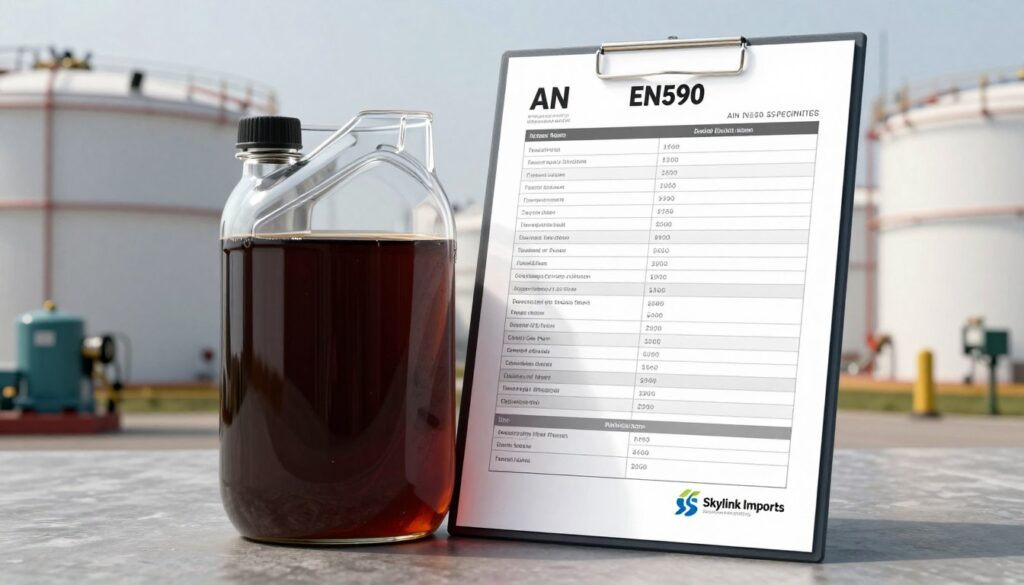
A sulfur figure alone does not establish that a shipment meets every EN 590 requirement.
For example, EN 590 also sets a minimum cetane number of 51. Cetane relates to how readily diesel ignites in an engine, while other limits address properties such as density, viscosity, water, and contamination. Buyers should compare the test results for the product offered with the full specification named in the purchase documents.
Suppliers may use “EN590 Diesel” or “EN590 10 PPM” in an offer, but those labels are not a substitute for product evidence. The buyer’s specification should identify the standard and any relevant grade or conditions. It should also make clear whether additional requirements apply to the intended equipment or destination.
Ask for evidence of the full EN 590 specification, not a sulfur figure alone.
Which EN 590 Specifications Should Buyers Check?
A buyer should compare the supplier’s complete test sheet against the EN 590 property limits, not just the sulfur line. Check each result beside its unit, test method, and stated temperature or condition. A certificate should report measured results and identify the methods used, rather than simply naming the standard.
The limits below cover core quality properties buyers commonly need to review. Some rows group related properties so the specification remains easy to compare with a supplier’s sheet. A result that looks close to a limit may not be comparable if its unit or test conditions differ.
Core composition and handling limits
Use the property name and the test method together. For example, a density result needs its reference temperature, while a viscosity result is tied to a stated test temperature. Buyers should also check whether percentages are by mass or by volume.
| Property | EN 590 limit | Test method or condition |
|---|---|---|
| Sulfur and cetane | Maximum 10 mg/kg sulfur; minimum cetane number 51 | Sulfur maximum EN ISO 20846 or EN ISO 20884; cetane: EN ISO 5165 |
| Density and flash point | Density 820-845 kg/m³; flash point minimum 55°C | Grades A-C at 15°C; flash point by EN 2719 |
| Viscosity and FAME | Viscosity 2.000-4.500 mm²/s; FAME maximum 7.0% by volume | Viscosity at 40°C by EN ISO 3104; FAME by EN 14078 |
| Water and contamination | Water maximum 0.020% by mass; contamination maximum 24 mg/kg | Water by EN ISO 12937; contamination by EN 12662 |
| Distillation and stability | Wear scar maximum 460 µm; PAH maximum 8%; ash maximum 0.010%; carbon residue maximum 0.30%; at least 85% recovered at 350°C; 95% recovery maximum 360°C; oxidation stability maximum 25 g/m³ | Lubricity by ISO 12156-1 at 60°C; ash by EN ISO 6245; carbon residue on 10% distillation bottoms before ignition-improver additives; stability by EN ISO 12205 |
Test methods and distillation limits
The table includes different types of measures: laboratory methods, temperature conditions, and percentage limits. The carbon-residue condition matters because the maximum applies to the 10% distillation bottoms before ignition-improver additives. Distillation results also need to show the recovery points specified for the test.
A common comparison mistake is reading a value without checking whether its unit, temperature, or method matches the specification. Do not compare a viscosity figure measured at a different temperature as though it were the same test. Confirm that every reported value uses the same test method and conditions as the specification.
Which EN 590 Grade Fits Cold-Weather Delivery?
A cold-weather grade should be selected for the conditions expected where and when the fuel will be used. Temperate EN 590 Grades A through F have maximum CFPP limits ranging from +5°C for Grade A to -20°C for Grade F. The right grade also depends on the buyer’s equipment requirements.
CFPP, or cold filter plugging point, measures a fuel’s ability to pass through a standardised filter under cooling conditions. Cloud point marks the temperature at which wax crystals first become visible. These are separate measures, so a CFPP value does not replace a cloud-point requirement.
EN 590 also includes Arctic or severe-winter Classes 0 through 4. Their maximum CFPP limits range from -20°C to -44°C, while maximum cloud-point limits range from -10°C to -34°C. These classes address colder operating conditions than the temperate grades.
For a Canadian destination, consider the expected conditions during the delivery and use period, as well as the requirements of the equipment that will burn the fuel. A grade chosen for one season or location may not suit another. The expected operating conditions, not the product name alone, should guide the requested cold-flow class.
Confirm the grade against destination conditions before the purchase specification is finalised.
How Do Canadian Diesel Sulfur Rules Affect a Purchase?
Canadian diesel sulfur requirements depend on the fuel category and where compliance is measured. The listed categories have a 15 mg/kg sulfur limit, but the compliance point is not identical for every use. Buyers need to match the fuel’s end use with the applicable Canadian standard and rule.
These limits distinguish sale-point requirements from a producer-or-importer requirement. The effective dates also differ by category, so a buyer should not apply one category’s timing or compliance point to another.
Limits by fuel category
| Fuel category | Sulfur limit | Compliance point | Effective date |
|---|---|---|---|
| On-road diesel | 15 mg/kg | Point of sale | September 2006 |
| Off-road diesel | 15 mg/kg | Point of sale | October 2010 |
| Locomotive diesel | 15 mg/kg | Producer or importer level | June 2012 |
| Non-large-vessel marine diesel | 15 mg/kg | Point of sale | June 2014 |
Standards and effective dates
Canadian automotive low-sulfur diesel standards include CAN/CGSB-3.517. The separate CAN/CGSB-3.520 standard covers automotive diesel with low levels of biodiesel. The applicable standard depends on the product and its intended automotive use, so the standard’s name should be clear in the purchase specification.
The locomotive rule is the important exception in this comparison: its compliance point is the producer or importer level, unlike the point-of-sale limits shown for on-road, off-road, and non-large-vessel marine diesel. Canada’s diesel sulfur requirements should be considered alongside the buyer’s product specification and intended use.
Identify the end use before deciding which Canadian limit and standard apply.
How Can Buyers Assess EN590 Diesel Suppliers?
Start supplier checks by verifying who is offering the product and what authority they have to represent it. A company name or introduction alone does not prove authority, product availability, or a supplier’s right to make an offer. Treat each proposed party and transaction as a separate business matter.
EN 590 gives buyers a clear product specification to request from a proposed supplier. Skylink Imports connects qualified buyers with reputable suppliers, refineries, and authorized mandates, but the buyer still needs transaction-specific evidence for the offer under review.
Use these checks before sharing a purchase commitment:
- Confirm the supplier’s legal identity and authority to offer the product.
- Check that the refinery or authorized mandate is identified.
- Request a product specification and supporting quality documentation.
- Verify that the proposed delivery arrangement and destination are stated in writing.
For an international trading company or another intermediary, ask what role it holds in the specific transaction. A named intermediary may connect parties, but that role does not by itself establish control of product or authority to bind a refinery. Keep the proposed supplier, its representative, and the contractual counterpart clear in the records.
Compare the documents with the offer itself. Names, product description, and delivery details should be consistent across the paperwork. If a proposed party cannot show what it is authorized to offer, avoid treating its message as a firm supply commitment.
Do not treat an introduction or mandate claim as a substitute for transaction-specific documentation.
What Is the Buying Procedure for Bulk EN590 Diesel?
A bulk EN590 purchase starts with a written request that clearly identifies the specification and destination. Include the product as EN 590, the requested 10 PPM sulfur content, and the Canadian destination. A complete request helps the buyer and supplier review the same requirements.
The buying procedure then moves through review of the product, quantity, destination, and delivery arrangement. Requested volumes and schedules describe the buyer’s needs; they do not mean that stock is available or reserved.
Define the purchase request
Set out the request in a short sequence so both parties can identify any missing terms before discussing a final commitment:
- Define the product and specification, including EN 590 and 10 PPM sulfur.
- State the required quantity and the Canadian destination.
- Request the supplier’s offer and supporting product documents.
- Agree on the transaction model and inspection arrangements.
- Confirm the final written terms before proceeding.
Review and agree on the transaction
The supplier’s offer should respond to the request rather than rely on assumptions about volume, schedule, or location. Review whether the product description matches the buyer’s specification and whether the destination is the same one named in the request. A change in either detail can affect the proposed arrangement.
Inspection procedures and the delivery model also need to be agreed as part of the transaction. Record who handles each step, which documents are required, and what must happen before the buyer authorises the next action. Do not treat a draft offer as the final agreement.
Proceed only when the product, quantity, destination, and agreed transaction steps are clear in writing.
How Do FOB, CIF, TTO, and TTV Differ?
FOB, CIF, TTO, and TTV describe different shipment or cargo-handling arrangements, so buyers should compare the actual obligations in each offer. A label alone does not settle who carries each cost, risk, or title-transfer duty. The contract must define the agreed delivery point and responsibilities.
FOB and CIF are shipment terms. TTO refers to tank-to-tank handling, while TTV refers to tank-to-vessel handling. Buyers may also see TTT used for tank-to-tank; clarify the intended operation rather than relying on an abbreviation.
FOB and CIF shipment terms
| Model | Cargo movement | Contract point to clarify |
|---|---|---|
| FOB | Shipment arrangement involving cargo loaded aboard a vessel | Named loading point and allocation of obligations |
| CIF | Shipment arrangement involving carriage and insurance to a named destination | Named destination and contract allocation of costs and risk |
| TTO | Tank-to-tank transfer of fuel between storage tanks | Tank location, transfer steps, and title point |
| TTV | Tank-to-vessel transfer of fuel from a tank to a vessel | Transfer location, cargo handling, and title point |
Tank-to-tank and tank-to-vessel models
TTO and TTV describe handling routes, not substitutes for a complete contract. A tank-to-tank offer needs to identify the tanks and the transfer arrangement. A tank-to-vessel offer should name the relevant vessel-side transfer point and specify who performs each handling step.
For all four models, check the written terms for delivery, risk, costs, and title transfer. Those duties may be allocated differently based on the contract and named locations. Have the contract name the delivery point and the point at which risk and title transfer.
Which Transportation Options Serve Canadian Diesel Buyers?
Canadian diesel distribution relies on several transport modes, with pipelines serving large-volume movement and trucks offering the most flexibility. Mode selection depends on the destination and the contracted delivery route. A route that works for one receiving terminal does not establish service to every other location.
Canada’s petroleum-product network moves fuel from refineries and ports to terminals and end users by pipeline, ship, rail, and truck. Pipelines are described as the safest, most reliable, and most cost-effective option for large volumes. Trucks cost the most but can serve flexible delivery needs.
Moving fuel through the Canadian distribution network
| Mode | Network role | Practical characteristic |
|---|---|---|
| Pipeline | Moves large volumes from supply points toward terminals | Safest, most reliable, and most cost-effective for large volumes |
| Ship | Moves petroleum products between ports and marine terminals | Atlantic Canadian petroleum-product terminals are serviced by marine tanker |
| Rail | Moves fuel between supply points and inland destinations | Route depends on available connections and terminal access |
| Truck | Delivers fuel to terminals and end users | Most expensive mode, with the greatest flexibility |
Examples of national network operators include Shell, Petro-Canada, and Imperial Oil. Regional refiners include Irving Oil, Ultramar, Suncor Energy, Federated Co-op, Husky, and Chevron. These examples do not mean that every company serves every route or destination.
Choosing a mode for the destination
For an Atlantic destination, account for the marine-tanker service to petroleum-product terminals and the onward movement needed after arrival. Other destinations may rely on a different mix of transport and terminal access. The buyer’s contract should state the quoted route rather than assume a standard path through the network.
Compare the proposed route with the receiving location, terminal access, and any inland movement needed to reach the buyer. Match the quoted delivery route to the actual receiving terminal and inland movement required.
How Are EN590 Cargo Quality and Quantity Checked?
A buyer can specify separate product-quality and quantity checks at loading and discharge. The contract should set out the procedures at both ends before the cargo moves. Independent inspectors named for cargo checks include SGS, Saybolt, and Intertek; these are examples, not endorsements or guarantees of a result.
Loading-port inspection provides a check before the cargo begins its movement. Discharge-port inspection provides a separate check when it reaches the destination. The contract should define the scope at each port and explain how the parties handle results that do not match.
Loading-port checks
At loading, the agreed process can address product sampling, laboratory testing, and quantity measurement. The buyer and supplier should identify what samples represent, which tests apply, and how the measurement is recorded. The procedures must match the written product and delivery terms.
Discharge-port checks
At discharge, the inspection can check product quality and delivered quantity against the agreed requirements. The contract should specify what happens if the results differ from the loading record, including how the discrepancy is documented and reviewed.
Before cargo movement, settle these four points in the contract:
- The agreed independent inspector, such as SGS, Saybolt, or Intertek.
- The sampling and testing scope at loading and discharge.
- The quantity measurement method for each agreed inspection point.
- The process for recording and resolving discrepancies.
Put the inspection scope and discrepancy process in the contract before cargo movement begins.
What Rules Apply to Fuel Carried on Vessels in Canada?
Canadian vessel rules distinguish packaged fuel in portable tanks from bulk oil carried in an integrated deck tank. Portable tanks used to carry packaged fuel on vessels must be approved for dangerous-goods transportation. The cargo configuration determines which requirements apply.
Portable tanks carrying oil or fuel as packaged cargo cannot be filled or discharged on a cargo vessel or barge deck. Filling and emptying must take place ashore. This restriction applies to the portable-tank packaged-cargo case, not to every tank arrangement aboard a vessel.
An integrated deck tank carrying bulk oil is a separate case when the tank is loaded or unloaded while aboard. That arrangement must meet applicable oil-tanker requirements. It is not treated as packaged cargo in a portable tank.
The Transport Canada Ship Safety Bulletin on oil and fuel transportation was modified January 13, 2026. Buyers arranging marine movement should identify whether the fuel is packaged cargo in a portable tank or bulk oil in an integrated deck tank. The distinction affects the handling rules that apply.
Canadian vessel fuel rules distinguish the cargo forms and their handling requirements. Confirm the cargo configuration and vessel requirements before arranging loading or discharge.
What Should Buyers Check at a Bulk Fuel Storage Site?
A Canadian bulk storage site must have tanks and venting arrangements suited to the hazards of flammable liquids. Vertical above-ground storage tanks need non-combustible foundations strong enough to keep them permanently in a true vertical position. The site operator should confirm that the relevant installation meets these requirements.
Above-ground tanks also require emergency pressure relief, in addition to normal venting, sufficient to prevent violent rupture during a fire. Emergency venting is a separate safety feature from the regular ventilation used during ordinary tank operation.
Tank foundations and emergency venting
Check that the foundation supports the tank permanently and maintains its vertical position. A tank that is not properly supported may not meet the stated foundation requirement. The venting arrangement needs both normal venting and enough emergency pressure relief for fire conditions.
Ask the site operator to confirm compliance for the specific tank and installation relevant to the planned storage. A general statement about a facility does not identify which tank will hold the buyer’s fuel or whether its design meets the applicable requirements.
Prohibited filling and tank designs
The Canadian Flammable Liquids Bulk Storage Regulations prohibit removing tank contents by applying air pressure. Open-top tanks are also prohibited for flammable liquids. These restrictions apply to storage arrangements, not to a buyer’s choice of product specification.
Do not accept air pressure as a method for removing tank contents.
What Determines a Bulk EN590 Diesel Quote?
A usable bulk-fuel quote needs the buyer’s specification, volume requirement, destination, and requested delivery arrangement. The final offer depends on the product specification, requested volume, destination, delivery arrangement, and timing. A quote request should include all five so the offer can be assessed against the buyer’s actual need.
State EN 590 10 PPM if that is the required product, then give the quantity and Canadian destination. Include the requested transaction model and target timing. These details help distinguish one procurement request from another without implying that a product is available or reserved.
The offer should state its applicable delivery and inspection terms. Compare the offered product specification with the one requested, and check that the delivery basis refers to the same destination and arrangement. If an offer changes any of these details, it may not answer the original request.
A quote prepared for one destination or delivery arrangement cannot be assumed to apply to another. A different receiving point may change the route and handling requirements. A different transaction model may also change the terms that need to be reviewed in writing.
Compare offers only after matching their product specification and delivery basis.
What Must a Buyer Confirm Before Importing Diesel into Canada?
Diesel imported for sale in Canada falls within the Canadian Sulfur in Diesel Fuel Regulations. The buyer should identify the intended fuel category and its compliance point before treating the product specification as complete. A fuel specification by itself does not fulfil every Canadian import or sale requirement.
The regulations cover diesel produced domestically or imported for sale in Canada. The applicable sulfur limit and compliance point depend on the fuel category. Buyers should confirm the relevant documents with the responsible Canadian authority or a qualified compliance professional.
Product and compliance documents
Use the product and sale details to identify which category applies. Keep the stated product specification consistent with the documents used for import and sale. Documentation should support the applicable category and compliance point rather than only describe the fuel as low sulfur.
The locomotive category has a distinct compliance point at the producer or importer level. That is different from the point-of-sale compliance point used for the other listed categories. A buyer importing fuel for locomotive use should account for that difference in the compliance review.
Destination and sale requirements
Confirm the destination and how the diesel will be sold or used in Canada. The intended use helps determine the fuel category and the applicable documents. A shipment’s origin or EN 590 designation alone does not decide its Canadian compliance treatment.
Confirm the product category and compliance point before treating an import specification as complete.
Skylink Imports: The Ultimate Bulk Diesel Fuel Supplier for Buyers
Skylink Imports focuses on petroleum-product and energy-commodity procurement and supply for buyers worldwide. The company connects qualified buyers with reputable suppliers, refineries, and authorized mandates. This role can support buyers preparing a defined request for EN 590 diesel in international trade.
For your request, set out the product, quantity, destination, and delivery arrangement you need. A clear request gives potential counterparties a basis for reviewing the proposed product and transaction. The company’s procurement role does not replace the buyer’s review of the documents and written terms for a specific offer.
Skylink Imports serves buyers considering supply across global markets. A buyer should assess each proposed supplier, refinery or mandate, product document, and delivery arrangement on its own merits. The identity of an intermediary should be clear in the paperwork, particularly when more than one organisation is involved.
Keep company names consistent with the transaction documents. Use Skylink Imports for the procurement and supply role described here. Do not treat “Skylink International Trading” as a synonym unless the transaction documents identify that entity as a party or representative.
This approach keeps the company’s role distinct from the obligations of the supplier and other transaction counterparties. Evaluate the specific supplier, product documents, and transaction terms presented for your request.
What Should Buyers Confirm Before Committing?
Before committing, check that the product, parties, destination, and transaction responsibilities are all recorded together. A preliminary offer or message is not a completed contract. The final record should match the buyer’s approved purchase request and identify who is responsible for each agreed step.
Review the full transaction record rather than relying on separate messages that may describe different terms. A consistent set of documents gives the buyer a clear basis for authorisation and reduces the risk of a product, route, or responsibility changing unnoticed.
Hold authorization until the final written terms match the buyer’s approved purchase request.
Before authorising a transaction, check these four areas:
- The EN 590 product specification and supporting product documents.
- The supplier’s authority and the named transaction counterparties.
- The destination, delivery model, and each party’s responsibilities.
- The inspection scope and the procedure for handling discrepancies.
Make sure the transaction record names the supplier and identifies the refinery or authorized mandate involved. The delivery model and inspection scope should appear alongside the destination and product details, not in unrelated documents with unclear status.
If any party, destination, or responsibility differs from the approved request, resolve the difference in the written terms before proceeding. Hold authorisation until the final written terms match the buyer’s approved purchase request.
Conclusion
A sound bulk diesel purchase starts with a precise specification and documented transaction responsibilities. Buyers can make a clearer request when the EN590 Diesel requirement, destination, and delivery terms are defined before reviewing an offer. The product specification should be supported by documents, and the proposed counterparty should be named in the transaction record.
Prepare the required product, quantity, destination, and preferred transaction model before contacting Skylink Imports through its official business contact channel. That information gives the procurement inquiry a defined starting point and lets the parties review a specific request. Prepare your product, quantity, destination, and preferred delivery model to begin a procurement inquiry with Skylink Imports.
FAQ
Is EN590 10 PPM diesel the same as 10 mg/kg sulfur?
What is the difference between EN 590 and Canada’s diesel sulfur limit?
Can EN 590 diesel be used in cold Canadian weather?
What is the difference between FOB, CIF, TTO, and TTV?
Which documents should I request from an EN590 Diesel Supplier?
Can portable fuel tanks be filled or emptied on a cargo vessel deck in Canada?
What information should I provide to request a bulk diesel quote?