
The strongest buying decision starts with a written specification and destination, not a product label. The Complete Buyer’s Guide to Best EN590 Diesel 10ppm begins with a simple measure: ppm means parts per million, and 10 ppm sulfur equals 10 mg/kg.
A buyer may see “EN 590 10 ppm” on an offer and still lack key facts about the cargo. The name alone cannot show whether the fuel fits the buyer’s equipment, use, or destination rules. A strong offer sets out measurable quality, sourcing, and delivery details.
This guide helps buyers compare specifications, trade terms, verification steps, and logistics before choosing an offer. It also shows where a familiar label leaves room for costly confusion. The first step is to define the quality requirements the cargo must meet.
Key Takeaways
- Match the written quality schedule to the intended use and destination.
- Name the exact standard, blend, climatic grade, and inspection basis.
- Compare offers using the same volume, pricing basis, and delivery term.
- Check seller authority, cargo evidence, and inspection arrangements independently.
- Plan the route, receiving tank, and discharge before committing.
What Should Buyers Verify in The Complete Buyer’s Guide to Best EN590 Diesel 10ppm?
Buyers should compare the full quality schedule with current EN 590 requirements, rather than relying on “10 ppm” alone. That label describes sulfur, not every property that affects diesel performance or acceptance.
EN 590:2025 sets maximum sulfur at 10 mg/kg, or 10 ppm. Buyers should check each listed limit and confirm the contract names the right version.
Ten ppm confirms only the sulfur ceiling. The full quality schedule must match the EN 590 version named in the contract.
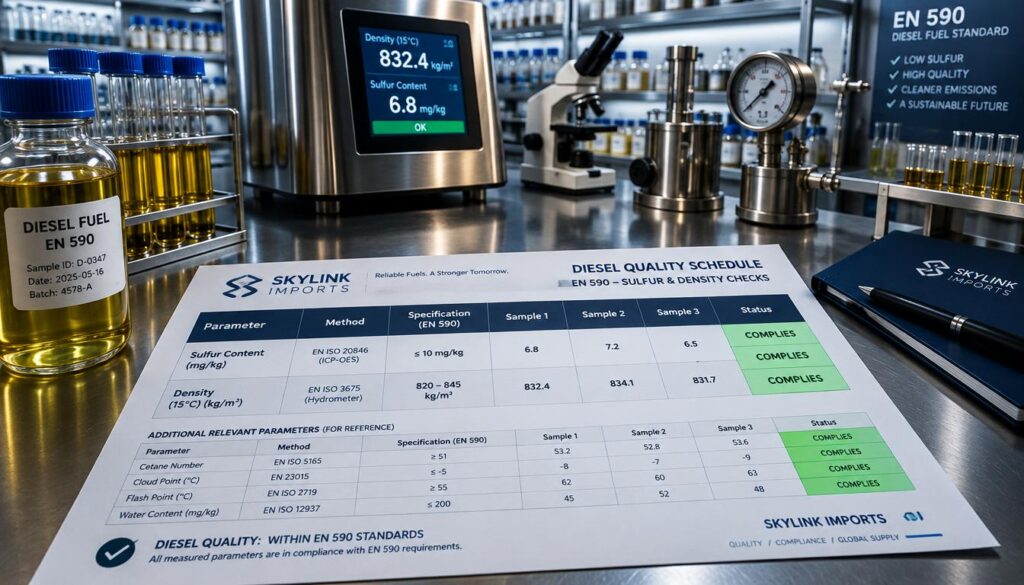
Core EN 590 quality limits
The standard sets limits for several properties, not just sulfur content. The grade and test results should appear in the contract’s quality schedule.
| Parameter | EN 590:2025 requirement | Buyer check |
|---|---|---|
| Sulfur content | Maximum 10 mg/kg (10 ppm) | Check the result and unit |
| Cetane number | Minimum 51 | Confirm the stated minimum |
| Flash point | Above 55°C | Check the test result exceeds 55°C |
| T95 | Maximum 360°C | Confirm the reported value |
| Summer-grade minimum density | 815 kg/m³ at 15°C for grades A, B, and C | Check the grade and temperature basis |
Changes buyers should check in EN 590:2025
The 2025 standard reduced the summer-grade minimum density from 820 kg/m³ in EN 590:2022 to 815 kg/m³. An old template can carry forward limits that no longer match the named version.
The range 820-845 kg/m³ is not a universal EN 590:2025 density range. Density limits depend on the grade and the standard being applied.
EN 590:2025 also sets a maximum of 10,000 particles/ml for particles at least 4 μm across. That count applies at the point of particle certification, using IP 630 procedures for measurement.
Buyers should ask whether the quality schedule includes this particle limit when relevant to the cargo and its certification. These checks establish what the automotive standard covers, but other market references can serve different purposes.
How Does EN 590 Differ From Other 10 ppm References?
Two offers can both say “10 ppm” yet name different governing specifications. The named reference determines whether the claim describes an automotive standard, a cargo assessment, or a legal rule.
A 10 ppm label does not prove EN 590 certification. Buyers should identify the exact reference and state it in the contract.
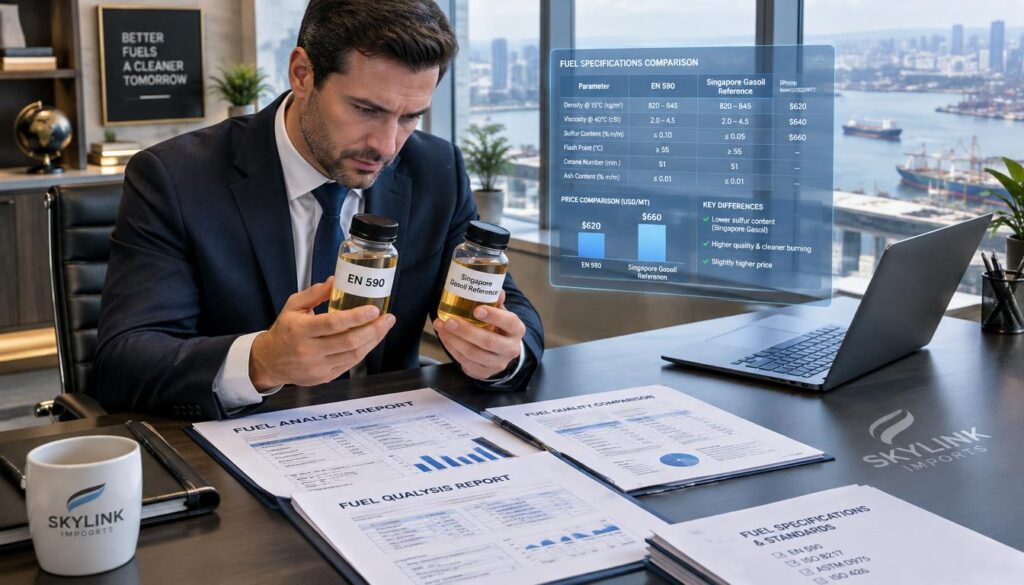
EN 590, Singapore cargo references, and road-diesel rules
EN 590 is an automotive diesel standard. Singapore 10 ppm gasoil is a physical cargo specification and assessment reference, not EN 590 certification.
| Reference | What it governs | Buyer distinction |
|---|---|---|
| EN 590 | Automotive diesel quality requirements | Name the version and grade in the contract |
| Singapore 10 ppm gasoil | Physical cargo specification and assessment | Not proof of EN 590 certification |
| Singapore motor-vehicle diesel rules | Statutory limits for vehicle diesel | Legal limits differ from a cargo assessment |
| ISO 8217:2024 | Marine-fuel family, including marine distillate | Use the applicable marine-fuel specification |
Singapore’s cargo reference lists density of 0.820-0.845 g/ml at 15°C and flash point of at least 66°C. It also lists viscosity of 2.0-4.5 cSt at 40°C, FAME NIL, and water at 200 mg/kg or less.
Its other listed properties include HFRR lubricity at 460 μm or less, CFPP at or below −5°C, and cloud point at or below −1°C. These values describe that cargo reference, not EN 590 certification.
Marine distillate and its separate standard
Singapore’s statutory motor-vehicle diesel limits include polyaromatics at 8 wt% or less, density at 15°C no higher than 845 kg/m³, and T95 no higher than 360°C.
Those rules also set FAME at 7% v/v or less and manganese at 0.002 g/L or less. A legal limit, cargo assessment, and automotive standard are not interchangeable.
A contract can name a price assessment separately from the quality specification. Marine distillate belongs to the ISO 8217:2024 marine-fuel family, rather than the automotive EN 590 grade. Once the reference is clear, buyers can choose the blend and climate grade their destination needs.
Which Grade and Blend Should Match the Destination?
A buyer who needs zero FAME should not accept an offer that says only EN 590. That wording does not promise a FAME-free blend.
EN 590 permits FAME up to 7% v/v, so buyers must contract B0 when zero FAME is required. The end use and destination should guide the grade and blend.
Specify FAME content instead of assuming B0
FAME is fatty acid methyl ester, a blend component allowed within the EN 590 limit. A buyer may need zero FAME for storage plans, blending needs, downstream acceptance, or company policy.
The offer and contract should state the required FAME content in clear terms. “EN 590” alone leaves room for a blend that does not meet a buyer’s needs.
Match cold-flow grade and clarify shorthand
Cold-flow properties depend on the climatic grade. The selected temperate or arctic grade should fit the destination and season, rather than a general product name.
“D2” is informal legacy shorthand, not a complete cargo specification. Buyers should resolve these details before asking for a price:
- Actual standard and version
- Sulfur limit and FAME requirement
- End use and required grade
- Quantity and destination
- Delivery term and inspection basis
Those details let a seller price the same product the buyer intends to receive. Once the product is defined, the quote can be judged against its price basis and delivery terms.
What Drives 10 ppm Diesel Pricing and Delivery Terms?
No single price follows from the 10 ppm label because route, trade term, volume, and quality affect the quote. The delivery basis changes which transport costs the seller includes.
A current price requires a transaction-specific offer. The quote depends on its pricing basis or benchmark, differential, volume, quality schedule, timing, destination, freight, insurance, and delivery term.
FOB, CFR, and CIF describe different arrangements for carriage and insurance. The named port matters because it defines the place or destination used in the deal.
| Trade term | Seller arranges | Buyer arranges or checks | Key cost distinction |
|---|---|---|---|
| FOB | Delivers goods on board at named shipment port | Main carriage | Buyer pays for main carriage |
| CFR | Carriage to named destination | Insurance | Seller pays carriage, buyer arranges insurance |
| CIF | Carriage and insurance to named destination | Confirm scope and delivery details | Seller pays carriage and insurance |
These terms do not replace the quality schedule or state every cargo obligation. The parties should record the named ports, covered costs, and handoff points in their agreement.
A buyer can request a quote by stating the standard, blend, quantity, route, timing, and delivery term. The seller can then price a defined cargo instead of a broad product label.
Price and contracted quality should appear as separate items. A low quote is not useful if the quality schedule, route, or delivery basis differs from the buyer’s needs.
Freight, insurance, and timing can change the delivered cost, while volume and the pricing basis shape the commercial offer. The next decision is whether the offer and seller can support those terms with credible evidence.
How Can Buyers Vet a Diesel Supplier and Offer?
An attractive offer may arrive with an incomplete specification or seller documents that cannot be checked. Pause before committing when the counterparty cannot support basic claims about the cargo.
Buyers should check seller identity, authority, origin, terminal evidence, and independent inspection arrangements. A polished offer does not prove that the seller controls the product.
Check that the seller’s company details match the offer and that its authority to sell can be confirmed. Screen the stated origin and parties against relevant sanctions rules.
Terminal or tank records should be credible and tied to the proposed cargo. Broker-chain assertions and unverified tank documents are not proof that diesel exists or can be sold.
For a broader procurement overview, buyers can review EN 590 supplier verification and delivery guidance.
Use this checklist before treating an offer as actionable:
- Counterparty credentials match the stated seller
- Authority to sell and cargo origin are checked
- Terminal evidence connects to the proposed cargo
- Offer details match the required specification
- Independent verification arrangements can be confirmed
Each check should connect to the same product and transaction. A mismatch between the offer, origin, and inspection plan is a reason to stop and clarify.
Once the seller and offer hold up to review, the buyer can record duties and transaction stages in the contract. That record should leave little room for disagreement about the cargo.
What Should the Contract and Transaction Process Include?
The SPA should define product quality, inspection, quantity, remedies, price basis, and delivery obligations. Clear terms give both parties a shared basis for handling the cargo.
The SPA is the sale and purchase agreement, and it should set the obligations that govern the deal. Parties should avoid treating a short offer as a substitute for a signed agreement.
Set a quoteable request and follow a documented sequence
A clear request lets the seller respond to a defined product and route. A practical process can include these six stages:
- Send a letter of intent (LOI) or request for quotation (RFQ).
- Review the seller’s offer against the requested cargo.
- Issue a buyer order with the agreed commercial details.
- Sign the SPA and confirm each party’s duties.
- Arrange inspection under the agreed contract terms.
- Load or deliver the cargo and match records to the deal.
The parties can adapt this sequence to their transaction. No single banking arrangement, inspection company, or timeline applies to every cargo.
Define the SPA and transaction documents
The SPA should name the governing quality specification, inspection point and basis, and test methods. It should also state how quantity is determined and who can access the inspection process.
Set out rejection rights, the remedy for off-spec cargo, price basis, delivery term, and payment conditions. Clear terms help the parties act if the cargo does not meet the agreed schedule.
Relevant records may include a commercial invoice, bill of lading, certificate of origin, inspection report, and load-port certificate of quality (CoQ). An insurance certificate may apply when the agreed delivery arrangement calls for it.
Parties should confirm which documents and banking arrangements fit their transaction instead of assuming one procedure works for all deals. The contract’s inspection terms then shape how the cargo’s quality and quantity can be checked.
How Should Cargo Quality and Quantity Be Inspected?
A certificate can exist even when the parties never agreed on its inspection point or test basis. That gap can make the result hard to use in a dispute.
Before loading, the parties should agree on where inspection occurs and how quality and quantity are measured. They should also define the result’s role under the SPA.
Agree on the inspection point and test basis
Load-port inspection checks the cargo at shipment, while destination checks occur after transport. The SPA should say which point controls acceptance and whether any second check applies.
Before loading, settle the inspection provider, sampling and test methods, certification point, quantity determination, and access. The parties should also agree on how they will handle an off-spec result.
Match certificates and results to the SPA
Compare the load-port CoQ with the signed quality schedule, including its test basis and stated certification point. A CoQ covers only the results and scope it records; it is not a blanket guarantee beyond that scope.
A practical review checks four points:
- Inspection point is agreed in the SPA
- Test basis and methods are named
- Quality and quantity results are recorded
- SPA remedies apply to a nonconforming result
Quality and quantity records should refer to the same cargo and contractual basis. A mismatch in lot, measurement point, or test method can weaken the evidence.
Inspection results become useful when they connect to the signed schedule and the agreed remedy. With those terms settled, the buyer can plan the cargo’s physical journey and receiving conditions.
What Should Buyers Plan for Shipping, Ports, and Storage?
A cargo can arrive at a named port while the receiving tank or discharge plan remains unready. Port naming alone does not secure a route, terminal, or storage slot.
Buyers should confirm port access, receiving capacity, discharge arrangements, shipping schedule, and storage readiness before committing. Each part must fit the cargo and the planned arrival.
Choose a feasible route and destination port
Rotterdam, Fujairah, Jurong in Singapore, and Houston are examples of ports used in international fuel trade. Their names do not guarantee current availability for a specific shipment.
Confirm that the proposed route can reach the named port and that the receiver can accept the cargo. A port name alone does not prove that a route, terminal, or storage slot is available.
Check the expected shipping schedule against the receiving plan. The receiver should know what cargo documents it needs and when those records must arrive.
Prepare storage and receiving arrangements
Storage tanks should be compatible with the fuel and ready to receive it. The buyer should check capacity, access, transfer equipment, and any cleaning or readiness needs.
Plan transfers to avoid contamination from water, residue, or another product. Coordinate the discharge plan with the terminal and the party responsible for receiving the cargo.
Storage readiness can affect whether delivery proceeds as planned. The buyer should align the ship’s arrival, discharge access, and tank availability before accepting a schedule.
These checks turn a delivery term into a workable receiving plan. With the port and storage needs clear, a sourcing request can state the details a provider needs to respond.
How Can Skylink Imports Support a Sourcing Request?
A quote request is most useful when it includes a complete specification, quantity, destination, and delivery basis. Specific details help a provider assess the right product and route.
Skylink Imports presents itself as “Global Energy & Fuel Solutions,” with sourcing and global logistics support for energy markets. Buyers can describe their needs without assuming availability, price, or timing.
Sourcing across energy and fuel markets
Skylink Imports states that it provides sourcing, quality-assured fuels, and global logistics support. Its stated markets include aviation, industrial, and energy buyers.
The company connects buyers with sources across EN 590 10 ppm diesel, Jet Fuel A1, LNG, LPG, crude oil, D6, bitumen, and other petroleum products. It also states support for spot transactions and long-term contracts.
Buyers can read more about Skylink Imports’ EN 590 diesel sourcing as part of their research. Any specific offer still needs to match the buyer’s stated requirements.
Prepare the request and contact Skylink Imports
A useful inquiry should include the required product specification, quantity, destination port, delivery term, and inspection basis. It should also state whether the buyer seeks a spot deal or contract supply.
That information gives the provider a clear starting point without assuming a set price or delivery time. Buyers can contact Skylink Imports by phone, WhatsApp, email, or its website.
- USA: +1 (432) 243-4545
- WhatsApp: +1 (432) 243-4545
- Email: info@skylinkimports.com
- Website: www.skylinkimports.com
Send a defined product, quantity, destination, and delivery basis. A complete request gives the seller a clear cargo to assess.
The next step is a simple decision rule: move forward only when the written offer fits the required cargo and its delivery plan.
Conclusion
A sound diesel purchase pairs a clear quality schedule with evidence that can be checked independently. Delivery terms must also fit the destination and receiving plan.
The buyer’s next step is to prepare an RFQ with the specification, blend, quantity, destination, trade term, and inspection basis. Those details help sellers respond to the cargo actually needed, not a vague label.
Before choosing an offer, compare its terms with the intended use and route. Then send the fully specified RFQ to a prospective supplier.
FAQ
Which brand of diesel fuel is the best to buy?
What is the difference between diesel and EN590 diesel?
What is the price of 10 ppm diesel EN590 today?
Is 10 ppm diesel good?
What is the current price of 10 ppm diesel?
What diesel to stay away from?
What is the cleanest diesel?
What is the most reliable diesel on the market?
- USA: +1 (432) 243-4545
- WhatsApp: +1 (432) 243-4545
- Email: info@skylinkimports.com
- Website: www.skylinkimports.com