


Buyers seeking a cross-border petroleum supply partner need clear product requirements and a verifiable transaction path. Skylink Imports specialises in procurement and supply for qualified buyers worldwide. It connects them with suppliers, refineries, and authorized mandates to facilitate transactions. Its role is sourcing and coordination, not a promise about the outcome of a particular deal.
Each business has different needs, from industrial fuel supply to energy commodities for multiple industries. Skylink Imports offers procurement solutions, while buyers assess the proposed counterparty and written deal for themselves. Review the supplier’s years of relevant activity, authority to sell, and ability to support the requested products. In addition, SGS inspection means independent inspection and testing of a fuel cargo against specified requirements. The title does not guarantee cargo quality, stock, price, delivery timing, or transaction completion.
Key Takeaways
- Skylink Imports coordinates qualified cross-border procurement.
- Define product and quantity in writing.
- Confirm inspection scope and delivery responsibilities.
- Check the specific counterparty and transaction.
Treat every proposed supply as a transaction to qualify against its written product, inspection, and delivery terms.
The Best Guaranteed Bulk Fuel Supplier in Houston | Skylink Imports: What Should Buyers Check?
For a qualified buyer arranging cross-border supply, Skylink Imports’ procurement role is the relevant fit. A local truck drop requires a separate check of delivery capacity and schedule. Skylink Imports coordinates sourcing and supply, but buyers needing a local delivery service should compare Houston-area jobber capacity directly.
Tank-wagon deliveries typically start around 1,000 to 3,000 gallons, while a full transport load is roughly 7,500 to 8,500 gallons. These ranges help you decide whether a local fleet can handle the order size and delivery window your site needs.
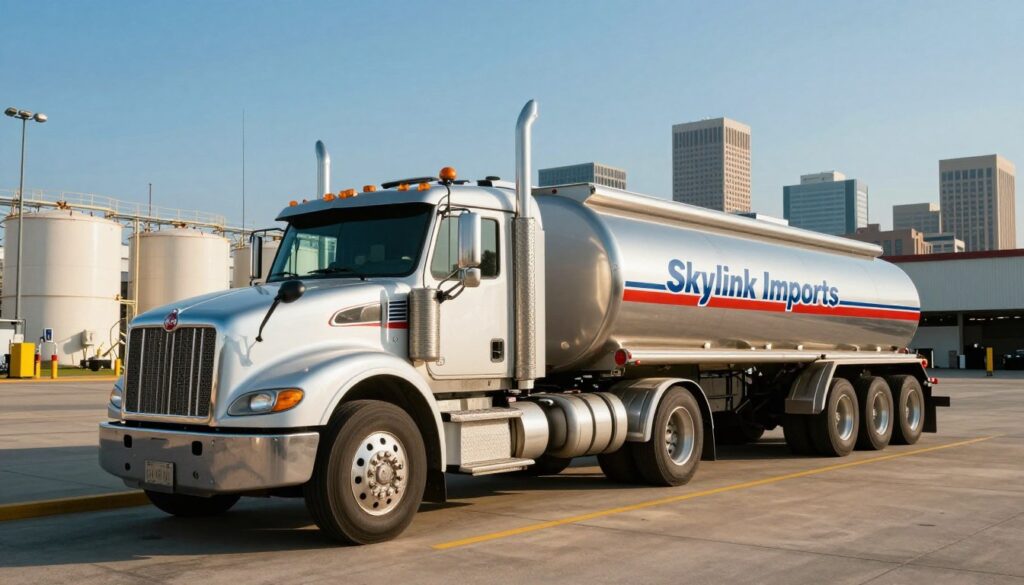
Match the supplier to the delivery scale
Houston listings show different minimums and schedules. Frontier Petroleum Services lists a 7,500-gallon minimum and scheduled-contract delivery. Anchor Petro Carriers lists diesel and biodiesel with a 2,500-gallon minimum and next-day delivery. Titan Fuel Logistics lists diesel with a 5,000-gallon minimum and scheduled-contract delivery.
A Houston-area listing is a comparison point, not evidence that a business partners with Skylink Imports or that Skylink Imports operates its local truck fleet.
Compare services Houston jobbers list by checking each stated minimum and schedule against your actual requirement. A next-day option may suit a time-sensitive site, while a scheduled contract may fit recurring demand. Ask about the requested drop size and receiving setup before assuming a delivery truck can serve the location.
When requesting local fuel delivery, specify four practical details:
- Product, including the requested fuel grade.
- Volume, stated in gallons or another clear unit.
- Destination, including the receiving site.
- Required delivery window, including any access limits.
Plan Houston and export logistics
Houston is a U.S. Gulf export hub for refined fuel. In April 2026, 165,000 tons of U.S. refined fuel discharged into Durban. Buyers may encounter Houston, Rotterdam, Fujairah, and Jurong in trade discussions, but a location name alone does not establish terminal access or custody.
Houston-to-Lagos and Houston-to-Durban fuel voyages were estimated at 18 to 25 days in 2026, depending on routing. Such transit estimates are not local truck schedules; vessel routing, port handling, and the receiving arrangement shape the export plan. The receiving site may also require a separate local delivery service after the cargo arrives.
For export planning, distinguish the port or terminal named in a discussion from the final receiving location. Confirm whether the quoted arrangement covers only procurement or also the physical delivery to the receiving site.
Which EN590 Diesel Specifications Should Buyers Confirm?
EN590 diesel is defined by measurable quality limits, including a maximum sulfur content of 10 mg/kg and a minimum cetane number of 51. Buyers should place the exact EN 590 grade and agreed test methods in the product specification.
For comparison, the U.S. diesel standard is ASTM D975 No. 2-D S15. Its limits differ from EN 590, so the standard names should not be treated as interchangeable proof of destination-market compliance.

EN590 quality limits
EN 590 sets density at 820.0-845.0 kg/m³ at 15°C and limits fatty acid methyl ester, or FAME, to 7.0% by volume. Viscosity is 2.000-4.500 mm²/s at 40°C. The minimum flash point is 55°C.
| Specification | EN 590 | ASTM D975 No. 2-D S15 |
|---|---|---|
| Sulfur | Maximum 10 mg/kg | Maximum 15 ppm |
| Cetane number | Minimum 51 | Minimum 40 |
| Viscosity at 40°C | 2.000-4.500 mm²/s | 1.9-4.1 mm²/s |
| Flash point | Minimum 55°C | Minimum 52°C |
| Lubricity wear scar | Maximum 460 µm at 60°C | Maximum 520 microns |
EN 590 also limits water to 0.020% by mass, total contamination to 24 mg/kg, and polycyclic aromatic hydrocarbons to 8% by mass. Temperate-climate CFPP limits range from +5°C for Grade A to -20°C for Grade F. CFPP is the cold filter plugging point, a measure relevant to cold-weather operability.
Compare EN590 with U.S. on-road diesel
U.S. federal diesel for mobile applications has a maximum sulfur limit of 15 ppm. That limit has applied to on-road diesel since 2006, nonroad diesel since 2010, and locomotive and marine fuel since 2012.
ASTM D975 No. 2-D S15 allows a higher sulfur limit and a lower minimum cetane number than EN 590. Its listed viscosity range is also different. Those distinctions matter when buyers specify bulk fuel for equipment with defined operating requirements.
The table highlights selected limits, not every fuel property or local rule. Buyers should match the requested grade and test methods to the contract and destination, since a standard name alone does not show every local requirement.
Fuel compatibility also depends on equipment requirements and intended use. Diesel equipment, lubricants, gasoline, and other products have distinct specifications; bulk fuel suitable for one application may not suit another. Put the required grade, test method, and destination-market requirements in the purchase specification before accepting a cargo.
How Does a Secure Bulk Fuel Buying Procedure Work?
A secure transaction starts with a written product and delivery brief, followed by independent checks on the counterparty and cargo. Record the product, quantity, destination, inspection scope, and required documents before advancing discussions. Clear terms give the buyer, supplier, and inspection team a shared basis for review.
The brief should identify the relevant fuel supply, intended use, delivery location, and documents needed at each stage. State the agreed sampling point, tests, methods, and reporting format. Then compare the proposed documents with the company and terminal involved, rather than relying on a sales summary.
Set out the product and transaction requirements
A Buying Procedure should identify the product and quantity before the parties discuss supporting records. It should also name the destination and define the inspection scope. This gives your team a written basis for reviewing an offer and spotting terms that do not match the intended fuel supply.
SGS Inspection is an available option for independent cargo inspection and testing. SGS fuel-oil testing can include sulfur, trace metals, viscosity, pour point, density, and D1160 distillation testing. Many SGS fuel-testing laboratories are accredited to ISO/IEC 17025.
Inspection is useful only within its agreed scope. Cargo trade inspections use accepted methods such as API, MPMS, ASTM, UOP, GOST, EN, or IP methods. The selected test methods should match the contract and be named before sampling begins.
An SGS report does not guarantee a transaction or replace checks on the supplier’s authority, custody, and documents. Buyers should confirm which cargo sample the report covers, what tests were completed, and whether the named methods match the purchase terms.
Verify the supplier, terminal, and inspection
Use a separate due-diligence checklist before treating paperwork as evidence of a valid offer:
- Confirm the company’s legal registration and trading licences.
- Verify inspection reports directly with the inspection company.
- Confirm terminal custody with the terminal operator.
- Screen beneficial owners and directors against sanctions lists.
Fuel distributors and authorized mandates may play different roles in a proposed deal, so identify the legal seller and the party authorized to act. Keep records of direct confirmations and note who provided each document. A polished file does not establish that its statements are current or authentic.
Make sure the people on your team know which party supplied each record and which company confirmed it. This distinction helps prevent a sales document from being mistaken for independent confirmation. Verify the inspection report with the inspection company and terminal custody with the terminal operator before relying on either document.
How Do FOB, TTT, TTV, and TTO Affect Delivery?
FOB identifies a delivery arrangement, while the contract must make the loading point and each party’s responsibilities explicit. Do not assume an abbreviation alone explains the full transfer process.
In Houston, wholesale fuel pricing is based on the daily terminal rack price plus freight, taxes, and the jobber’s margin, and it changes daily. A quote should show the pricing basis and the period for which the stated terms apply.
Clarify FOB responsibilities
FOB is an international delivery term. The contract needs to name the agreed loading point and set out each party’s tasks for loading, documents, transport arrangements, and handoff. It should identify the party responsible at every named stage instead of relying on an assumed meaning.
FOB does not by itself tell you how a specific terminal handles custody records or how the parties divide every operational duty. State the applicable contract rules and describe the handoff in language both sides can follow. A clear location name matters because a loading point cannot be inferred from a general port or city reference.
Keep the delivery point distinct from the destination address and any later local delivery service. The agreement should show which leg is covered by the quoted arrangement. That distinction helps your receiving team understand where the seller’s stated responsibilities end and another delivery provider’s work begins.
TTT, TTV, and TTO describe different transfer arrangements, not interchangeable shortcuts. The contract must define the operation, custody, and risk for the arrangement actually used.
Define transfer and price terms in writing
TTT means tank-to-tank transfer, TTV means tank-to-vessel transfer, and TTO means tank-to-truck transfer. These terms are not universally standardised, and a particular structure may not be available for every transaction. The agreement should spell out the facility, equipment, sequence, and party responsible for each movement.
A tank-to-tank transfer is not the same physical operation as loading a vessel or a truck. Set out how the quantity is measured and what record confirms completion. Include the required delivery documents and identify the party that issues each one, so the receiving team knows which records to expect.
For Houston wholesale offers, confirm how the daily rack price is applied, how freight and taxes are handled, and whether the jobber’s margin is stated separately or included. Also confirm the delivery point, documentation, timing of title and risk transfer, and any payment conditions in the signed agreement.
Compare quoted deliveries on the same basis, including the stated price period and exact receiving point. A quote that omits those details can leave the buyer unable to compare the total arrangement with another offer. Before authorising payment, make sure the signed terms identify the product, price basis, delivery point, and responsibility for each transfer.
Conclusion
A dependable fuel transaction depends on a clearly specified product and verifiable delivery responsibilities. A procurement partner should help define the requested supply, while your written terms identify what the counterparty will provide and where its role ends.
For a qualified cross-border requirement, prepare a concise brief before discussing the offer. Include the grade, quantity, destination, and preferred delivery structure, along with the inspection scope that fits the purchase. This gives the conversation a defined business purpose without treating a proposed supply as a completed transaction.
Before your next supplier call, prepare the required grade, quantity, destination, and preferred delivery structure, then contact Skylink Imports to discuss the procurement requirement.