


U.S. buyers can source EN590 through bulk-trade channels, but should verify the fuel specification and the seller’s ability to deliver before making a commitment. EN590 is commonly handled as an import/export product in the United States, not standard domestic pump fuel.
Houston is a major setting for bulk procurement, but a supplier directory is not an endorsement of any seller. This guide suits buyers weighing a spot purchase or a longer supply contract. FOB means the supplier’s delivery is complete when goods are loaded aboard the buyer-nominated vessel at the named port of shipment.
A Houston offer may name a port without proving that fuel is ready at a terminal. Treat a Houston FOB offer as a transaction to verify, not proof that the product is already available at a terminal.
Key Takeaways
- EN590 is often offered through international bulk trade in the United States.
- Match the grade to the receiving market and intended use.
- Ask for quality records tied to the actual batch.
- Check the supplier, payment beneficiary, inspection plan, and delivery path.
- Compare total delivered cost, not only the quoted FOB price.
- Put the product and shipment terms in a signed sales and purchase agreement.
What EN590 Means for U.S. Bulk Buyers
EN590 is a European automotive diesel specification with a maximum sulfur content of 10 ppm, and U.S. buyers usually encounter it in bulk import/export offers. It applies to diesel for uses such as passenger vehicles and commercial vehicles.
The EN590 name alone does not prove that a specific shipment meets the specification. A buyer needs the offered grade and quality evidence for the batch under discussion.
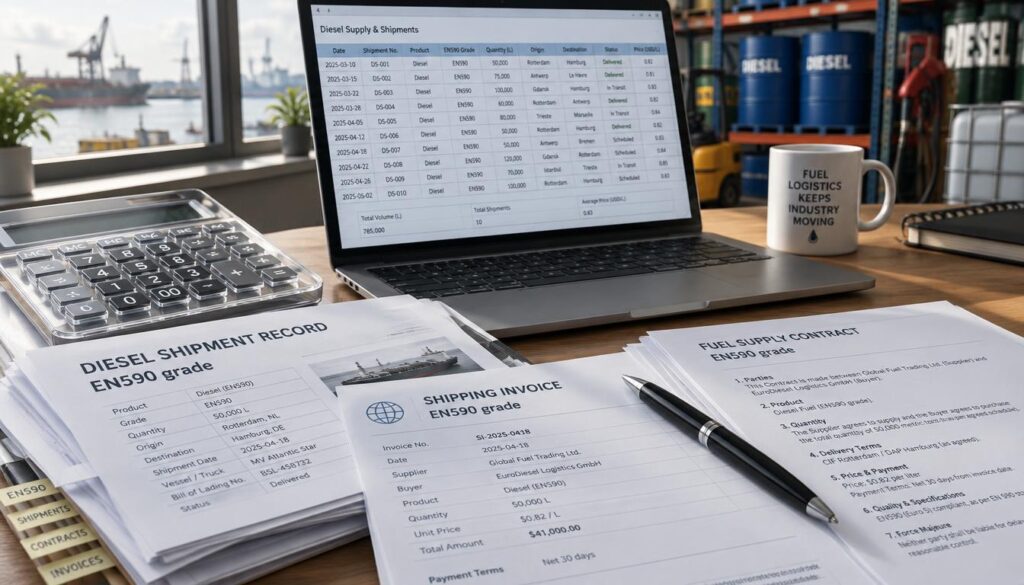
Ask for the applicable grade and a shipment-specific quality document before treating an offer label as a specification.
In the U.S. market, domestic diesel commonly follows ASTM D975, while EN590 often appears in international trade. The standards describe product requirements for different markets.
The term diesel fuel EN590 may appear in a listing, proposal, or contract. Read the product description closely, since the exact grade and test basis matter more than a broad label.
Buyers may also see gas oil used in trade descriptions. Do not assume that a familiar product name confirms a particular set of properties or end use.
The EU automotive diesel specification describes EN590 as a European fuel standard. Use the contract’s product specification to assess the actual goods offered.
Ask the supplier to state which EN590 grade applies, how the batch was tested, and which document reports the results. A general brochure cannot answer those shipment-specific questions.
Ask for the applicable grade and a shipment-specific quality document before treating an offer label as a specification.
EN590 and ASTM D975 Serve Different Markets
EN590 and ASTM D975 are different standards, and the right choice depends on the destination market and the buyer’s contractual specification. Their sulfur limits differ, but sulfur alone does not decide compliance.
Confirm the receiving market’s required standard rather than assuming that a lower sulfur number settles every compliance question. The destination regulator, equipment maker, and purchase contract shape the applicable requirement.
The EN590 specification in export offers
EN590 is a European automotive diesel specification used in export-market offers. Its sulfur maximum is 10 ppm, a limit buyers can compare with their destination needs.
Export offers may use the term ULSD, or ultra-low sulfur diesel, alongside a grade name. Ask the supplier to identify the precise standard rather than relying on a broad term.
The U.S. domestic diesel standard
U.S. ULSD under ASTM D975 has a sulfur limit of 15 ppm. ASTM D975 is the U.S. domestic diesel specification, not another name for EN590.
The two standards are not interchangeable labels for every parameter. A lower sulfur limit does not show that all other properties meet the receiving market’s rules.
| Attribute | EN590 | ASTM D975 |
|---|---|---|
| Specification market | European automotive diesel | U.S. domestic diesel |
| Sulfur limit | 10 ppm maximum | 15 ppm maximum for ULSD |
| Typical role | International trade grade | Domestic U.S. diesel grade |
| Buyer’s compliance check | Destination rule and contract | U.S. rule and contract |
Compare the buyer’s intended use with the standard named in the contract. The destination regulator and equipment maker may set needs beyond a sulfur figure.
Confirm the receiving market’s required standard rather than assuming that a lower sulfur number settles every compliance question.
Verify EN590 Quality Before Buying
A credible EN590 offer should state measurable limits, beginning with a sulfur maximum of 10 ppm. Check each value against the contracted grade and the quality evidence for the batch.
Ensure the batch identifier on the quality evidence matches the shipment being sold. A refinery or source claim is only one part of that check.
Core laboratory limits
Use the table to review key EN590 limits. The buyer’s laboratory or inspector should confirm the test basis and reported units.
| Test | EN590 value | Unit | Buyer’s check |
|---|---|---|---|
| Sulfur | Maximum 10 | ppm | Batch test result |
| Cetane number | Minimum 51 | Number | Test method and result |
| Density at 15°C | 820-845 | kg/m³ | Test temperature |
| Viscosity at 40°C | 2.0-4.5 | mm²/s | Test temperature |
| Flash point | Minimum 55 | °C | Reported test result |
The typical boiling range is 180-360°C, and carbon residue has a maximum of 0.3%. Review these values in the product specification and batch test results.
Refinery and shipment evidence
An EN590 refinery claim should be checked against a batch-specific certificate of quality and product specification. Agree in writing when samples are taken and what the inspection covers.
A claim about the refinery or source does not establish that the contracted batch meets the grade. The EN590 requirements summary also lists key diesel properties, including sulfur and cetane limits.
Check that the test document names the product and batch, and that its values match the specification in the sales and purchase agreement. Ensure the batch identifier on the quality evidence matches the shipment being sold.
Match Seasonal Grade to Destination Conditions
The EN590 seasonal grade matters because cold-filterability limits range from +5°C for class A to -20°C for class F. Select a class for the destination’s expected conditions, not only the loading point.
Put the required seasonal class in the purchase specification, not only in a logistics email. A contract needs to state the grade that applies to the fuel being supplied.
Temperate-climate classes
EN590 classes B through F have progressively lower limiting filterability temperatures. Use the table to tie the stated class to the buyer’s operating plan.
| Class | Limiting filterability temperature | Buyer’s planning check |
|---|---|---|
| B | 0°C | Expected conditions near freezing |
| C | -5°C | Expected conditions below freezing |
| D | -10°C | Colder operating period |
| E | -15°C | Severe cold exposure |
| F | -20°C | Lowest listed class in this range |
Cold-weather selection
Class A has a +5°C limiting filterability temperature. The full class range runs from that limit to class F’s -20°C limit.
Choose the class against expected temperatures at the final delivery location and the timing of use. A shipment that leaves a warm port may still reach a cold destination later.
The loading port can shape a buyer’s first view of the weather, but it is not always the place where the fuel will be used. Put the required seasonal class in the purchase specification, not only in a logistics email.
EN590 Diesel Suppliers USA: How Buyers Should Vet Offers
The best EN590 supplier for a bulk buyer is the one whose identity, product evidence, and delivery path can all be independently checked. A strong offer gives a buyer specific facts, not just a company profile and a price.
Pause the transaction if the supplier’s legal identity and the payment beneficiary do not match. A U.S. address or listing does not prove refinery ownership, available stock, or Houston terminal access.
Verify the business and authority to sell
Check that the supplier’s legal name matches its contract and invoice. State Secretary of State registries can help confirm business registration.
Registration does not prove authority to sell a specific cargo. The U.S. Department of Commerce provides international trade guidance for businesses, while buyers still need transaction-specific evidence.
Test the offer against the transaction
Check whether the supplier can show the product’s origin and batch evidence, explain the loading plan, allow inspection, and provide consistent payment instructions. These details make a listing easier to assess.
- Match legal names across business records, the contract, and the invoice.
- Verify the supplier’s authority and the stated supply chain.
- Check that delivery details identify a real loading or handoff plan.
- Confirm the independent inspection plan before accepting the offer.
A supplier name may appear in several listings, but the transaction still needs a clear legal seller and a specific product. Sellers should identify the party that can sign the contract and arrange the cargo.
Pause the transaction if the supplier’s legal identity and the payment beneficiary do not match.
Check Documents and Inspection Before Commitment
Request shipment-specific quality and origin records before relying on a general product brochure. Keep the batch and product description consistent across every record, including the contracted grade.
Agree who appoints and pays the inspector before the cargo is loaded. The written plan should name the inspection scope, location, and timing.
Quality and origin records
Ask for a certificate of quality (COQ), material safety data sheet (MSDS), certificate of origin, and contracted product specification. Compare the product name and batch details across these records.
Confirm documents with the named issuer or terminal using contact details you obtain independently. A document that looks complete may still need direct confirmation.
Quantity and loading records
Review the commercial invoice, packing list, and bill of lading or delivery order. The Q&Q inspection, meaning quality and quantity inspection, should follow the contract’s agreed scope.
SGS and Intertek are inspection providers buyers may encounter. Include the inspection report only when the parties have agreed to that inspection.
- Certificate of quality tied to the shipment batch.
- Material safety data sheet and product specification.
- Certificate of origin with a consistent product description.
- Commercial invoice, packing list, and transport record.
- SGS or Intertek inspection report when contracted.
Agree who appoints and pays the inspector before the cargo is loaded. Make sure the inspection location and timing fit the loading plan.
Choose a Delivery Method That Fits the Purchase
A delivery plan works only when the shipment format matches the buyer’s receiving facility and onward transport. Confirm tank compatibility and transfer access before fixing the delivery route.
Bulk tanker, tank-farm transfer, truck, and barge each suit different delivery paths. A receiving setup may limit the practical options before a shipment is booked.
| Delivery or storage method | Typical fit | Handoff point | Buyer’s facility check |
|---|---|---|---|
| Bulk tanker | Large waterborne cargo | Named port or terminal | Berth and tank access |
| Terminal tank transfer | Stored fuel handoff | Terminal tank connection | Tank access and grade match |
| Truck or barge | Local onward delivery | Receiving site or dock | Road, dock, and transfer access |
ISO tanks and flexitanks are other shipment formats. Their fit depends on the buyer’s receiving setup and the transport plan.
Separate tanks for different grades help prevent cross-contamination. A tank that held another product may need checks before receiving diesel.
Ask the receiving terminal whether it can accept the proposed format and transfer method. Confirm any permits required for the planned delivery.
Confirm tank compatibility and transfer access before fixing the delivery route.
Plan a Houston Bulk Loading Transaction
A Houston bulk transaction needs a specific terminal and loading point, not just a city name on an offer. “Houston” alone is not a complete loading instruction.
The buyer’s vessel must be nominated with the specific loading place and point within the port in time for loading. Port-level detail is not a substitute for a working schedule.
Confirm the actual terminal and loading point with the relevant transaction parties. A Houston-based supplier or listing does not establish inventory at a Houston terminal.
Ask for the nomination deadline and confirm the vessel suits the terminal’s loading setup. Vessel compatibility can affect whether the stated schedule is workable.
Coordinate terminal access and the transfer schedule before fixing the loading date. Keep the parties’ agreed timing in the written transaction record.
A vague offer may name a port but leave the loading point unclear. That gap can affect the buyer’s vessel plan and the supplier’s ability to load.
Confirm that the terminal details match the named port in the contract. Put the confirmed terminal and vessel nomination details in the transaction record.
Compare FOB and CIF Responsibilities
FOB and CIF differ chiefly in who arranges and pays for carriage and insurance, not in the point where shipment risk transfers. FOB is a sea or inland-waterway trade term under which the supplier’s delivery is complete when goods are loaded aboard the buyer-nominated vessel at the named port.
Incoterms® 2020 FOB applies only to sea or inland-waterway transport. Under FOB, risk transfers when the goods are loaded aboard that vessel.
The supplier handles export formalities and loading under FOB. The buyer contracts the carrier and pays port-to-port transport costs.
| Responsibility | FOB | CIF |
|---|---|---|
| Export clearance and loading | Supplier handles both | Supplier handles export and loading |
| Main carriage and insurance | Buyer arranges and pays carriage | Supplier arranges carriage and insurance |
| Risk-transfer point | Goods loaded aboard nominated vessel | Goods loaded aboard vessel at shipment |
With CIF, the supplier arranges and pays carriage and insurance to the named destination port. Risk still transfers when the goods are loaded aboard the vessel.
For FOB, the buyer must give the supplier the vessel’s name and the specific loading place and point within the port in time for loading. The two quotes therefore place different tasks on each party.
Write the named port and the precise agreed Incoterm rule into the signed contract.
Follow a Documented Procurement Workflow
A bulk fuel purchase should move through written checks and agreed milestones rather than informal promises. Do not authorize payment or loading until the SPA identifies the product, quantity, inspection, and delivery terms.
A written inquiry should state the grade, quantity, destination, and Incoterm. Clear terms give both sides a basis for reviewing the offer.
From inquiry to signed contract
Check identity and compliance details before reviewing the offer. The sales and purchase agreement (SPA) should set the product specification, schedule, payment terms, and inspection plan.
Acronyms such as ICPO or FCO do not replace a signed contract or independent checks. Read the proposed terms before making a commitment.
Inspection through shipment closeout
Arrange the agreed inspection before loading, then track loading and shipment records. Reconcile the final documents and confirm delivery against the contract.
- Send an inquiry and complete KYC, or know-your-customer, checks.
- Review the offer and match its product specification to the purchase need.
- Sign the SPA and agree payment conditions.
- Complete the Q&Q inspection and loading steps.
- Reconcile shipping documents and follow up on delivery.
Where the parties agree, SGS or Intertek may carry out the inspection. The contract should state the inspection arrangements, not leave them to informal messages.
Do not authorize payment or loading until the SPA identifies the product, quantity, inspection, and delivery terms.
Understand EN590 Price Quotes and the Cheapest Offer
An EN590 bulk quote depends on the grade, origin, shipment details, and agreed delivery terms, so a headline number alone cannot establish the lowest viable cost. A usable current quote must match the actual transaction and date.
Buyers asking for an EN590 10 ppm price today or an EN590 diesel price today need a written quote for their specified shipment. Headline price leaves out costs that may change the final amount.
What moves a bulk quote
A quote can depend on grade, origin, quantity, timing, loading point, inspection scope, benchmark formula, and payment terms. The supplier should state which basis supports the offer.
Platts is a petroleum price-assessment benchmark used in some commercial offers. Its use in a formula does not make it a guaranteed price source.
Compare delivered cost, not headline price
Compare total delivered cost, including grade, origin, quantity, timing, inspection, freight, insurance, and payment terms. FOB and CIF quotes assign transport and insurance tasks differently.
The cheapest EN590 diesel suppliers in the USA may not offer the lowest viable cost. A low number can be outweighed by weak quality evidence, freight, insurance, inspection, or payment risk.
Ask sellers to quote on the same grade, quantity, delivery point, and payment basis. Compare the full cost to the receiving location, not one line in an offer.
Compare written quotes on the same grade, quantity, delivery point, and payment basis.
Decide Between Spot Purchases and Longer Contracts
A spot purchase suits a defined one-time requirement, while a longer contract suits buyers who can plan recurring demand and meet its commitments. Match the contract duration to a demand forecast the receiving operation can actually support.
Spot transactions and longer petroleum supply contracts can both state a grade, delivery schedule, inspection terms, and payment conditions. The commitment length changes how much supply planning the buyer takes on.
A spot purchase can fit a discrete need when the buyer can accept shipment-specific availability. It gives the buyer a defined transaction rather than a recurring supply duty.
A longer agreement can set recurring quantities and delivery dates. It also creates obligations that continue beyond one shipment.
Compare flexibility, supply continuity, volume commitments, and exposure to changing price formulas. Neither format guarantees execution without clear contract terms.
A buyer should avoid a long commitment before confirming receiving capacity and performance remedies. A schedule that exceeds the site’s ability to receive fuel can create a costly mismatch.
Spot terms can address one shipment, while longer terms can define repeat deliveries and remedies if performance falls short. Put those duties in the contract.
Match the contract duration to a demand forecast the receiving operation can actually support.
Avoid Common Transaction and Payment Risks
A transaction becomes higher risk when the supplier’s identity, product evidence, or payment instructions change without a verifiable explanation. Stop and independently confirm any payment-beneficiary change before funds move.
Names and batch details should stay consistent across the contract and shipment records. A sudden change deserves close review before a buyer accepts it.
Document and product inconsistencies
Check for mismatched legal names, batch identifiers that do not line up, and origin claims that cannot be confirmed. A product specification that changes between offer and contract also needs an explanation.
Commercial fuel offers commonly name a legal entity, SPA, invoice, and payment beneficiary. Compare those names and shipment details before sending funds.
Pressure tactics and payment changes
Be cautious about urgent requests for unusual fees, last-minute beneficiary changes, or payment to an unrelated party. Pressure to bypass inspection is another warning sign.
- Legal names do not match across the transaction records.
- Documents cannot be authenticated with the named issuer.
- Payment instructions change without a verified reason.
- Inspection is blocked or materially changed.
Verify a payment change through a trusted contact channel, not the new message carrying the request. Seek legal or banking review when a material concern remains.
Stop and independently confirm any payment-beneficiary change before funds move.
SKYLINK IMPORTS’ Role Across Petroleum Products
SKYLINK IMPORTS describes its role as connecting buyers to sources across a range of petroleum products and transaction types. That service description is the company’s stated scope, not an independent finding about performance.
The company says it supports buyers seeking products for different markets and deal structures. Each proposed shipment still needs its own review.
Product categories in the company’s stated scope
SKYLINK IMPORTS lists EN590 10PPM diesel, Jet Fuel A1, LNG, LPG, crude oil, D6, and bitumen within its stated product range.
These products have different uses and specifications. A buyer should not treat one product’s quality records as evidence for another product.
Support for spot and longer-term transactions
The company describes its role as connecting buyers with sources across the supply chain. It states that its support covers spot transactions and long-term contracts.
SKYLINK IMPORTS presents reliability and lasting buyer relationships as service commitments. Buyers can assess each proposed offer through its own records and agreed terms.
Every product needs its own specification, origin evidence, inspection, and delivery terms. Evaluate each proposed product and shipment on its own documents and contract terms.
Request a Transaction-Specific Quote
A useful EN590 quote request states the required grade, quantity, destination, and delivery basis. Ask for an offer tied to your shipment, not an unverified listing.
Buyers looking to buy EN590 or find EN590 10 ppm for sale should send details that let the supplier assess the transaction. Specific terms make the offer and inspection plan easier to review together.
Send the inquiry with enough shipment detail for the offer and inspection plan to be checked together.
Include the quality evidence, origin, loading plan, and payment terms in the requested offer. If the proposed delivery is FOB, the buyer must nominate the vessel and specific loading point in time for loading.
Use this five-part checklist to frame the inquiry:
- Requested grade and specification, such as EN590 10PPM.
- Required quantity and preferred shipment timing.
- Destination and receiving setup.
- Incoterm and named port.
- Inspection needs and contract preference.
SKYLINK IMPORTS lists info@skylinkimports.com and USA +1 (432) 243-4545 for inquiries. Include enough detail for the company to respond to the stated shipment needs.
A clear inquiry lets the buyer compare a proposed supply with the receiving plan and contract terms. Send the inquiry with enough shipment detail for the offer and inspection plan to be checked together.
Conclusion
A defensible EN590 purchase starts with a specification the destination accepts and evidence tied to the actual shipment. Check the supplier’s identity and the delivery duties before you commit.
For a useful quote, state the required grade, volume, destination, and Incoterm. Contact SKYLINK IMPORTS at info@skylinkimports.com or USA +1 (432) 243-4545 with the shipment details needed for a quote.