


Elevate Your Business with Skylink Imports’ Reliable Best Fuel Supply
Bulk buyers need a clearly specified product and a verifiable transaction process before they commit to an international purchase with Skylink Imports. Skylink Imports specializes in petroleum product and energy commodity procurement and supply. It connects qualified buyers with suppliers, refineries, and authorized mandates. For Canadian bulk buyers, that role may support commercial procurement across international trade, but each offer needs careful review.
EN 590 is a European automotive diesel fuel specification that sets fuel-quality limits and climate-grade requirements. Before committing, check the product specification, transaction procedure, inspection arrangements, and delivery responsibilities in writing. This service page explains how to frame those checks and what details belong in a qualified inquiry. Treat every offer as subject to written verification of product, delivery terms, and transaction documents.
Key Takeaways
- Request the specific EN 590 grade and product limits in writing.
- Agree on independent inspection criteria before payment or transfer.
- Make the Incoterm and transfer steps clear in the contract.
- Confirm Canadian import documents and handoff responsibilities.
- Ask Skylink Imports to confirm each inquiry’s product and delivery details.
Why Does Canada’s Refined Petroleum Import Market Matter to Bulk Buyers?
Canada imported 485,000 barrels per day of refined petroleum products in 2025, making supplier concentration a practical consideration for importers. That volume was 3% higher than in 2024, while imports cost $21.4 billion, 1.2% less than the previous year. Supplier concentration matters because the United States supplied 386,000 barrels per day, or 79.6%, of imports.
The Netherlands supplied 24,000 barrels per day, or 4.9%, in 2025. These shares show how much Canada’s import supply depended on its largest supplier. A buyer assessing international trade can use that context to discuss sourcing exposure, routes, and continuity with a supplier.
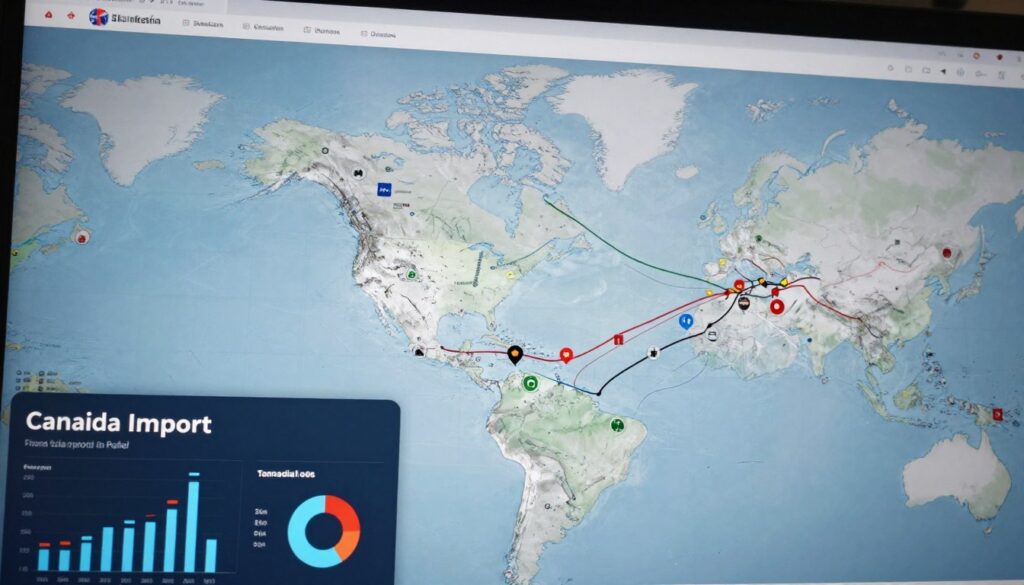
A dominant import route can concentrate exposure to supply-chain disruption.
Canada also exported 403,000 barrels per day of refined petroleum products in 2025, valued at $18.7 billion. That export activity existed alongside imports, not instead of them. From 2015 through 2019, imports averaged 536,000 barrels per day, higher than the 2025 volume.
Those national totals do not establish a particular buyer’s route, price, or access to product. Businesses should treat each prospective shipment as a separate commercial transaction, with its own product and delivery details. Use national trade totals as market context, not as proof that a specific shipment is available.
Which EN590 10 PPM Diesel Specifications Should Buyers Verify?
For an EN 590 10 PPM Diesel purchase, the sulfur ceiling is 10 mg/kg, but sulfur is only one part of the specification. Put the complete contracted specification and destination requirements in writing; selected limits alone do not prove full compliance.

Core fuel-quality limits
Use the limits below to review a product offer and its test results. Conditions matter: density and viscosity limits apply at stated temperatures.
| Test | EN 590 limit | Test condition |
|---|---|---|
| Sulfur | Maximum 10 mg/kg | Diesel fuel |
| Cetane number | Minimum 51 | Diesel fuel |
| Density | 820.0-845.0 kg/m³ | At 15°C, temperate Grades A-C |
| Viscosity | 2.000-4.500 mm²/s | At 40°C |
| Flash point | Minimum 55°C | Diesel fuel |
Other EN 590 specifications in 2026 include a cetane index minimum of 46 and maximum water content of 0.020% by mass. Total contamination is limited to 24 mg/kg. Lubricity has a maximum corrected wear scar diameter of 460 µm at 60°C.
Polycyclic aromatic hydrocarbons are limited to 8% by mass, ash to 0.010%, and carbon residue to 0.30% by mass on the 10% distillation bottoms. Copper strip corrosion after three hours at 50°C must be Class 1. Distillation requires at least 85% volume recovery at 350°C and no more than 65% at 250°C. These specifications support quality review, but the contract and destination rules still govern acceptance.
Cold-weather grades and blending rules
The maximum cold filter plugging point (CFPP) differs by climate grade. The 2026 EN 590 cold-flow limits distinguish temperate grades from arctic or severe-winter classes.
| Grade | Climate category | Maximum CFPP |
|---|---|---|
| A | Temperate | +5°C |
| B | Temperate | 0°C |
| C | Temperate | -5°C |
| D | Temperate | -10°C |
| E | Temperate | -15°C |
Temperate Grade F has a maximum CFPP of -20°C. Arctic or severe-winter Classes 0 through 4 have respective maxima of -20°C, -26°C, -32°C, -38°C, and -44°C.
For blending, the EU Fuel Quality Directive allows diesel FAME content up to 10% by volume, while EN 590 sets a 7% maximum in 2026. The Directive also requires an EU-wide B7 protection grade because some vehicles are not compatible with B10, and that fleet is expected to remain sizable by 2030. Match the contracted cold-flow grade to the destination’s expected operating conditions rather than relying on the 10 PPM label alone.
How Can Buyers Assess EN590 Diesel Suppliers and SGS Inspection?
A credible supplier should be willing to let the buyer verify both its authority and the product against agreed specifications. Check the supplier’s legal identity, authority to offer the product, and consistency across company and payment details. Ask for a supply route that can be independently confirmed. An inspection checks agreed product criteria; it does not guarantee future performance or replace written acceptance terms.
SGS lists diesel sampling, bulk cargo trade inspection, laboratory analysis, and testing to BS EN 590 in 2026. Its capabilities include sulfur, cetane number, density, flash point, water and sediment, lubricity, cloud point, and cold filter plugging point tests. A buyer and supplier must agree whether SGS will be appointed for a particular transaction.
Before inspection begins, set these five points in the contract or inspection instructions:
- Sampling plan and sampling point.
- Sample identification and custody records.
- Laboratory tests agreed by both parties.
- Acceptance limits tied to the contract.
- Written results and the report recipient before payment or transfer.
Testing the relevant product attributes helps the buyer compare results with the contract, while clear custody records show which sample was tested. Put the sampling point, test scope, acceptance limits, and report recipient in writing before inspection begins.
What Buying Procedure and Documents Should a Diesel Transaction Follow?
A sound Buying Procedure starts with a specific written requirement, not with a payment instruction. The buyer’s product, volume, destination, delivery basis, and acceptance terms should align before transaction documents or payment steps are considered. Documents and payment instruments serve different purposes, and none proves product, title, or funds on its own.
Qualify the buyer and confirm the offer
Use a buyer-led sequence to make the proposed trade clear. The order may differ by transaction, but each point should be resolved between the parties.
- State the product and grade.
- State the volume and destination.
- Confirm the delivery basis and timing.
- Verify the supplier’s authority and supply route.
- Agree on inspection and acceptance criteria.
This information gives businesses a practical starting point for an import process. It also helps each party assess whether the proposed international trade fits its operating and compliance needs.
Match documents to payment and performance
An ICPO, or Irrevocable Corporate Purchase Order, communicates a buyer’s proposed purchase. It does not establish that product exists or that a supplier has title. TSA/CPA refers to storage or charter arrangements when relevant, and its use depends on the transaction.
A commercial invoice records sale details, while PPOP means Proof of Product Availability. PPOP is a seller-provided availability document that requires independent verification. An SGS inspection records the testing agreed by the parties; it does not automatically establish every contract obligation.
MT103 is a SWIFT payment message type, not a substitute for checking the contract or beneficiary details. Parties may encounter these terms and documents, but they do not form a universal mandated procedure. Have qualified legal and banking advisers review the contract and payment controls before funds move.
How Do FOB, TTT, TTV, and TTO Affect Delivery?
FOB and TTT, TTV, and TTO do not describe the same part of a transaction: FOB is a delivery term, while the others are transfer-procedure shorthand. FOB identifies delivery on board the buyer-nominated vessel at the named port under the agreed Incoterms rules. Write the named place and responsibilities into the contract rather than treating shorthand as a complete delivery term.
Define the FOB delivery point
FOB and CIF allocate delivery and responsibilities differently. CIF includes cost, insurance, and freight to the named destination port, while delivery and risk allocation differ from FOB.
| Term | Delivery arrangement | Buyer’s key confirmation |
|---|---|---|
| FOB | Seller delivers goods on board the buyer-nominated vessel at the named port | Named port, vessel nomination, and agreed Incoterms rules |
| CIF | Seller includes cost, insurance, and freight to the named destination port | Destination port and the separate delivery and risk allocation |
In international trade, the named port and the agreed Incoterm shape the buyer’s logistics planning. The buyer should confirm the applicable Incoterms rules and version in the contract.
Clarify tank and vessel transfer procedures
TTT, TTV, and TTO are transaction shorthand, not standardized Incoterms. Their exact steps, custody point, title transfer, tank access, and evidence must be written into the contract. A label alone does not show what happens at each stage.
The buyer and supplier should reconcile the named port, vessel or tank arrangements, and inspection point before accepting a procedure. That review helps align physical logistics with the agreed chain of custody and contractual obligations. Require the contract to identify the exact point where delivery, custody, and risk change hands.
Can Elevate Your Business with Skylink Imports’ Reliable Best Fuel Supply Meet a Bulk Buyer’s Needs?
Skylink Imports is positioned to connect qualified buyers seeking petroleum products and energy commodities with potential supply counterparties. Skylink Import Export Inc. describes its role as procurement and supply, linking qualified buyers with suppliers, refineries, and authorized mandates. That role is an intermediary connection, not a guarantee of a specific cargo or supply outcome.
For each inquiry, confirm the product, origin, volume, availability, delivery structure, and transaction requirements. These details can shape whether a proposed supply route fits your business and import services needs. A global market connection does not by itself confirm a particular product or shipment.
Skylink Imports’ stated scope includes petroleum products and energy commodities. If your sourcing brief covers a broader commodity, ask whether that product falls within the relevant mandate. Any tailored solutions, commercial terms, or delivery plan need transaction-specific confirmation.
A qualified inquiry should give the supplier enough detail to assess the request without assuming that availability, pricing, or timing is already set. Send a written inquiry that identifies the requested product, specification, volume, destination, and preferred delivery basis.
What Canadian Import and Logistics Checks Should Buyers Complete?
A shipment can meet its product specification and still face delays if its Canadian import documents and handoffs do not align. Canadian importers must meet applicable Canada Border Services Agency requirements for imported goods. Assign each customs and freight task to a named party before dispatch.
Use this pre-shipment checklist to catch gaps between the contract and the planned movement of goods:
- Confirm importer-of-record responsibilities.
- Check applicable Canadian product and border requirements.
- Reconcile commercial invoice and bill of lading details with the contract.
- Verify the freight route, handover points, and receiving arrangements.
A complete cargo file can still face a handoff problem when no party owns customs clearance.
Cross-border shipping paperwork commonly includes a commercial invoice and bill of lading. Shipment-specific documentation and regulatory compliance depend on the goods and route, so confirm requirements with the relevant Canadian authorities and customs professionals.
Logistics may involve air, sea, or land freight, along with warehousing, distribution, shipment tracking, and route planning. Customs clearance coordination, freight handling, and supply-chain support can involve several businesses. Identify who manages each task, including at the receiving point. Confirm the Canadian importer of record and document responsibilities before the cargo is dispatched.
Conclusion
A reliable bulk transaction begins with details that can be checked, documented, and agreed by both parties. Your written product specification, verification plan, and delivery responsibilities should align before you commit. A clear contract makes the proposed supply easier to assess for compliance and execution.
Prepare a transaction brief with the product, grade, volume, destination, required inspection, and preferred delivery basis. Then request transaction-specific confirmation from Skylink Imports. This gives both sides a clear starting point for discussing sourcing, logistics, and the proposed supply route.
Request written confirmation of the proposed product, supply route, inspection arrangements, and delivery basis before proceeding.