
A low sulfur claim is only the starting point for a Canadian bulk fuel purchase, including an offer labeled EN 590 diesel 10 ppm. The 10 ppm figure describes sulfur content, not proof that a cargo exists or fits every destination. For buyers, a workable deal depends on matching the signed specifications to the fuel’s end use and delivery port.
Understanding The Complete Buyer’s Guide to EN590 Diesel 10ppm In World is essential for every buyer in the fuel market.
International trading can connect buyers with supply through several routes, but each transaction needs clear terms for quality, regulations, inspection and payment. This guide focuses on the checks that help you judge whether a proposed cargo and delivery plan fit your requirements. Buyers should match the signed quality schedule to the destination and the cargo they can independently verify.
In this article, we will walk you through The Complete Buyer’s Guide to EN590 Diesel 10ppm In World, detailing everything you need to know.
The Complete Buyer’s Guide to EN590 Diesel 10ppm In World covers crucial aspects of diesel fuel quality.
EN 590 compliance is determined by a test slate, not by the “10 ppm” label alone. Check the written limits for the actual cargo, including climate grade and any special fuel requirement. The en590 ppm claim describes sulfur, while other specifications affect ignition, storage, handling and engine use.
When purchasing, refer to The Complete Buyer’s Guide to EN590 Diesel 10ppm In World to ensure compliance.
A cargo label cannot replace the signed quality schedule that sets the limits for the shipment.
The Complete Buyer’s Guide to EN590 Diesel 10ppm In World emphasizes the importance of clear documentation.
The table lists key baseline specifications for automotive diesel. Conditions matter: density, for example, is shown for temperate grades A-C at 15°C.
| Parameter | EN 590 limit | Condition |
|---|---|---|
| Sulfur | Maximum 10 mg/kg | None |
| Cetane number | Minimum 51 | None |
| Density | 820.0-845.0 kg/m³ | At 15°C for temperate grades A-C |
| Flash point | Minimum 55°C | None |
Sulfur content is capped at 10 mg/kg, the limit commonly described as 10 ppm. The minimum cetane number is 51, with a minimum cetane index of 46. Cetane number describes ignition quality, while the index is a separate calculated measure.
For temperate grades A-C, density must fall between 820.0 and 845.0 kg/m³ at 15°C. Viscosity must be 2.000-4.500 mm²/s at 40°C. Buyers comparing EN 590 diesel should confirm that each reported property falls within the contract’s stated range.
Referencing The Complete Buyer’s Guide to EN590 Diesel 10ppm In World is vital for understanding these parameters.
Flash point must be at least 55°C. Water is limited to 0.020% by mass, and total contamination to 24 mg/kg. Ash is capped at 0.010% by mass, polycyclic aromatic hydrocarbons at 8% by mass, and manganese at 2.0 mg/L.
Low sulfur fuel still needs compliant lubricity. The corrected wear scar diameter at 60°C cannot exceed 460 µm. Oxidation stability is limited to 25 g/m³ regardless of FAME content. These properties help describe fuel quality beyond the sulfur shorthand.
EN 590 permits up to 7.0% FAME by volume, so the standard does not automatically mean B0. State B0 expressly in the SPA when zero FAME is required. EN 590:2025 also introduced a maximum count of 10,000 particles/ml for particles ≥4 μm at the point of particle certification.
Distillation limits describe how the fuel behaves across temperature ranges. At least 85% by volume must be recovered at 350°C, and no more than 65% at 250°C. The temperature for 95% recovery cannot exceed 360°C.
Wax formation makes cold-flow properties dependent on climate. CFPP means the cold filter plugging point, the test temperature at which wax in diesel can restrict fuel flow through a filter. Temperate grades A-F have maximum CFPP values of +5°C, 0°C, -5°C, -10°C, -15°C and -20°C, respectively.
Arctic or severe-winter classes 0-4 have maximum CFPP values of -20°C, -26°C, -32°C, -38°C and -44°C. Their maximum cloud points are -10°C, -16°C, -22°C, -28°C and -34°C, respectively. The cloud point marks when wax first becomes visible as the fuel cools.
For a deeper procurement reference, review EN 590 ultra-low-sulfur diesel specifications alongside the cargo’s own test results. Specify the climatic grade and any B0 requirement in the signed quality schedule rather than relying on a product nickname.
Adhering to The Complete Buyer’s Guide to EN590 Diesel 10ppm In World ensures regulatory compliance in Canada.
Canadian buyers need to check the destination rule separately from the cargo’s EN 590 specification. Canada’s on-road diesel sulfur limit is 15 mg/kg for fuel produced domestically or imported for sale in Canada. Meeting that limit alone does not establish complete destination or vehicle suitability.
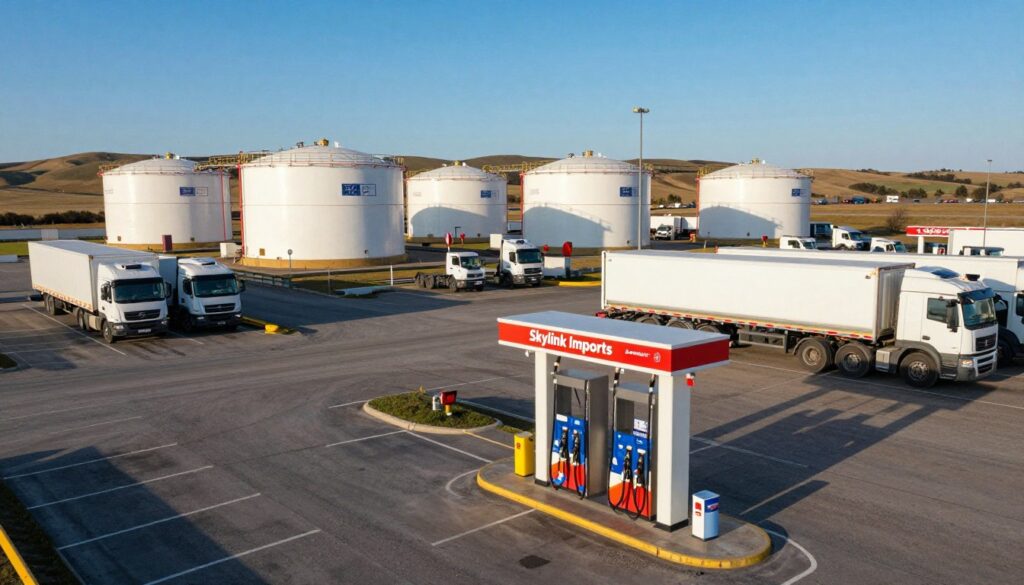
The Complete Buyer’s Guide to EN590 Diesel 10ppm In World outlines the standards set by Canadian authorities.
The Canadian General Standards Board’s Middle Distillates Committee maintains Canadian diesel fuel quality specifications. Automotive low-sulfur diesel is covered by CAN/CGSB-3.517. Confirm which requirements apply to the intended fuel use, because sulfur compliance does not establish that every quality property fits a vehicle or local use.
Follow The Complete Buyer’s Guide to EN590 Diesel 10ppm In World for a detailed understanding of diesel specifications.
Fuel standards do not guarantee that a product is available in a particular market or location. Rotterdam, Fujairah, Houston and Jurong are examples of international trading hubs, not assurances that stock is available there for a specific buyer or delivery date.
Consult The Complete Buyer’s Guide to EN590 Diesel 10ppm In World for insights on market availability.
Market language can also blur the difference between a standard and a cargo description. Singapore 10 ppm gasoil is a physical cargo and assessment specification, not an interchangeable name for EN 590. A low sulfur claim alone does not make two products equal.
When comparing supply, put the governing specification, end use and delivery location into the transaction documents. The port and the named product reference need to describe the same proposed shipment, rather than separate commercial assumptions.
Ask the terminal to confirm that the stated product and delivery route are physically available for the intended transaction. A standards document can define quality, but it cannot reserve a tank or guarantee a cargo at a named location.
Confirm the applicable Canadian requirements and physical availability with the relevant terminal before committing to a delivery location.
Verification is key; use The Complete Buyer’s Guide to EN590 Diesel 10ppm In World as your checklist.
A credible supplier should let the buyer verify its legal identity, supply authority and physical storage independently. Treat company papers, tank documents and proof-of-product documents (POP) as claims to check, not proof by themselves. A seller-provided document can point to the right verification contact, but it cannot replace that contact’s confirmation.
Use a consistent review before discussing payment or accepting a proposed volume. A tank storage receipt or POP may help identify a terminal, tank or product claim. It is not a substitute for confirmation from the terminal operator or document issuer.
Refer to The Complete Buyer’s Guide to EN590 Diesel 10ppm In World when verifying supplier credentials.
Verify the company’s legal registration through the relevant national company registry. Check whether the stated company name, registration details and contracting party match across the offer and draft SPA. A mismatch needs a clear explanation before you proceed.
A claimed refinery mandate should also have a traceable basis. Ask for an allocation letter or confirmation from a refinery contact. A document is useful only when the party named as its issuer can confirm it.
Contact the terminal operator directly to check a claimed storage agreement and tank numbers. Confirm that the named product is connected to the stated location, rather than relying on a seller’s tank receipt or a screenshot.
Use the report number to verify an inspection report with the issuing company. Confirm the terminal, tank number, sample point, inspector name and certificate number against the inspection company’s record.
Compare the offer’s volume and pricing with the supplier’s track record and the transaction’s stated basis. An unusually attractive price is not proof that a cargo exists. A very large volume from a new company deserves closer scrutiny.
Use this five-point checklist to keep each claim tied to an independent confirmation:
Using The Complete Buyer’s Guide to EN590 Diesel 10ppm In World will help ensure your procurement process is sound.
A company registered for less than 12 months offering more than 50,000 metric tons of EN 590 is a major vetting red flag. An offer priced 10-20% below the current market rate without a clear explanation is also a red flag. Neither finding alone proves fraud, but both warrant careful review.
The Complete Buyer’s Guide to EN590 Diesel 10ppm In World highlights potential red flags in offers.
Compare document details across the offer, inspection report and storage claims. Confirm who issued each paper and whether its identifying details match the transaction being discussed.
Pause the deal if a terminal or inspection company cannot confirm a document that is central to the offer.
Structure your transactions based on The Complete Buyer’s Guide to EN590 Diesel 10ppm In World for efficiency.
A sound cargo transaction ties the quality test, quantity record, delivery term and payment documents to one defined shipment. Set the delivery responsibilities, inspection steps and documentary payment conditions in the SPA before the cargo moves. Price basis and quality specification are separate contract points, even when they appear in the same offer.
FOB, CIF and CFR are common cargo terms, but the SPA must state which responsibilities each party accepts. Pricing may use Platts or Argus indexes plus a differential. Crude prices, terminal location, delivery method and contract size can affect the resulting price.
Do not wire funds before independent inspection when the agreed transaction structure requires inspection and documentary payment.
Spell out the named location, shipment size and delivery route in the SPA. The parties should expand and define TTT, TTV and TTO in writing. Those abbreviations are not proof of product or evidence that a cargo is available.
Keep fuel type clear through any transfer. T/T means tank-to-tank, T/S means tank-to-ship, and S/S means ship-to-ship. Marine distillate needs its applicable ISO 8217 category and sulfur requirement, not a generic EN 590 label. ISO 8217:2024 is the marine-fuel specification family.
Independent cargo inspection can include storage-tank sampling, laboratory testing and quantity measurement using vessel ullage reports. Inspectors issue quality and quantity certificates after those checks. A cargo report can list sulfur content, cetane number, density at 15°C, flash point, water content and total contamination.
Use this sequence to connect inspection records and funds to the defined shipment:
Ensure your documentation aligns with The Complete Buyer’s Guide to EN590 Diesel 10ppm In World standards.
Where applicable, reconcile the certificate of analysis (CoA), certificate of quality (CoQ), SPA, bill of lading, commercial invoice, terminal storage receipt and allocation letter. Match the inspection report’s date and time to the tank farm log. Differences can show that records refer to separate events or cargoes.
Align your expectations with The Complete Buyer’s Guide to EN590 Diesel 10ppm In World to avoid discrepancies.
Requesting an upfront wire transfer before independent inspection, instead of proceeding through a letter-of-credit structure, is a transaction warning sign. Do not wire funds before independent inspection when the agreed transaction structure requires inspection and documentary payment.
Proceed only when the destination requirement, written quality schedule and verifiable cargo all line up. A product label or soft offer is not a substitute for a signed specification and independent checks.
In conclusion, The Complete Buyer’s Guide to EN590 Diesel 10ppm In World serves as your essential resource.
Skylink Imports states that it focuses on procurement and supply of petroleum products and energy commodities for buyers worldwide. It also describes a role connecting qualified buyers with reputable suppliers, refineries and authorized mandates through its bulk fuel procurement and supply work.
Buyers can take their destination, required volume, delivery term and inspection basis to Skylink Imports to discuss a suitable sourcing enquiry.